 EN

The Harsh Realities of Coastal Courts and Paddle Degradation
Coastal sand courts expose athletic gear to harsh conditions. A durable beach tennis paddle must withstand abrasive quartz sand, airborne salinity, ultraviolet radiation, and thermal shifts. Conventional rackets suffer structural fatigue before hitting playability degrades. When sand grains lodge against composite faces, micro-abrasion strips away topcoats, causing micro-cracking across laminates. Off-center smashes impose severe torsional strain on the beach tennis racket frame, causing perimeter splitting. Twisting across the beach tennis racket frame impairs control during rallies. For beach clubs, equipment failure generates financial losses. Moisture intrusion through unsealed drilled holes accelerates foam rot, leaving an EVA core beach tennis paddle unresponsive. Selecting a durable beach tennis paddle requires understanding how composites endure coastal impacts. A reinforced carbon fiber beach tennis racket delivers the torsional stiffness needed to withstand heavy smashes without delaminating. In humid conditions, an EVA core beach tennis paddle must resist moisture absorption and cell collapse. Players choosing a durable beach tennis paddle preserve shot consistency while extending gear longevity. Equipment reliability starts by understanding how marine microclimates degrade the beach tennis racket frame and weaken a carbon fiber beach tennis racket.
Face Materials Comparison: Fiberglass, Carbon Fiber, and Kevlar
The face of a beach tennis racket absorbs impact while resisting sand friction. Entry-level paddles utilize fiberglass with tensile strengths between 3,100 and 3,400 MPa. However, low modulus causes rapid fatigue, allowing abrasion to initiate fractures along the beach tennis racket frame. Players seeking longevity transition toward a carbon fiber beach tennis racket. Advanced 3K weaves and 12K fabrics reaching 4,900 MPa tensile strength ensure the durable beach tennis paddle resists surface buckling. Toray T700 weaves eliminate stress concentrations around drilled holes. In tournaments, a carbon fiber beach tennis racket maintains surface tension longer than fiberglass. Hybrid laminates integrating Kevlar provide tensile damping between 180 and 210 GPa. Combining Kevlar with carbon creates a durable beach tennis paddle that deflects impacts without cracking. Selecting an EVA core beach tennis paddle wrapped in structural carbon ensures cohesion across rallies. Competitors rely on an EVA core beach tennis paddle reinforced with multi-axial fibers to maximize accuracy. Investing in an advanced carbon fiber beach tennis racket protects athletes from cracking along the beach tennis racket frame. Upgrading to a durable beach tennis paddle ensures the beach tennis racket frame maintains structural integrity. An EVA core beach tennis paddle engineered with composite reinforcements provides the definitive solution.
Internal Core Dynamics: Choosing the Right EVA Foam Density
Beneath the composite face lies the shock-absorbing core. An EVA core beach tennis paddle balances rebound velocity, vibration absorption, and durability. Low-density EVA 13 to 15 formulations provide a forgiving response. However, softer foams suffer cell collapse when exposed to sunlight exceeding 35 degrees Celsius. An unreinforced EVA core beach tennis paddle loses its springiness when subjected to ultraviolet radiation. High-density EVA 17 to 20 cores deliver firm directional control. A high-density EVA core beach tennis paddle prevents the face from sinking during smashes, reducing delamination risks. Selecting a durable beach tennis paddle engineered with closed-cell EVA foam prevents humidity absorption. When paired with a rigid carbon fiber beach tennis racket, firm cores distribute strike forces into the perimeter beach tennis racket frame. Impacts weaken an inferior beach tennis racket frame if foam fails to disperse energy. Competitors ensure their chosen durable beach tennis paddle features high-memory EVA foam that recovers its shape instantly. Equipping a carbon fiber beach tennis racket with high-density foam guarantees predictable response during rallies. A well-constructed durable beach tennis paddle delivers resilience, transforming a carbon fiber beach tennis racket into an enduring tournament weapon.
Structural Geometry: Hole Drilling Patterns and Frame Reinforcement
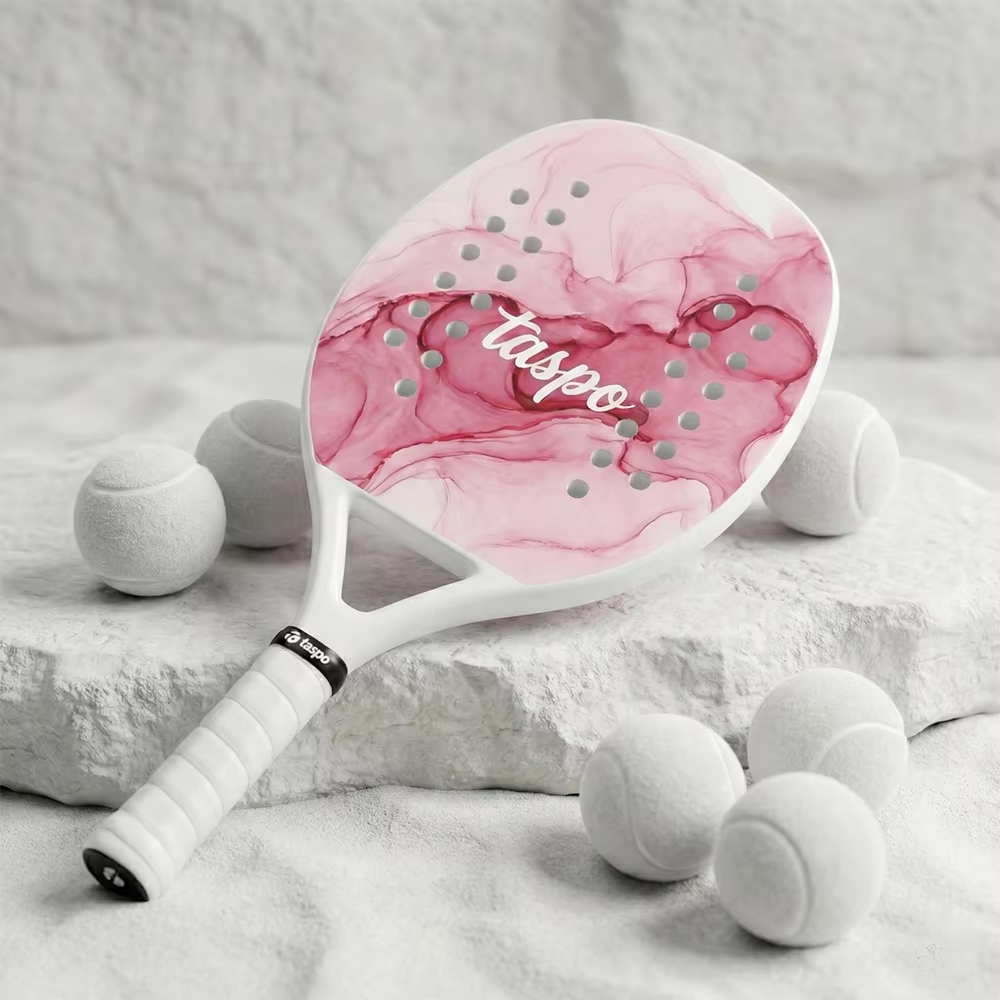
Structural longevity depends on perimeter architecture and hole drilling mechanics. Under ITF specifications, paddle profiles measure between 20mm and 22mm thick, with length restricted to 50 centimeters. In an optimized durable beach tennis paddle, outer borders utilize a continuous tubular profile. Internal reinforcement throughout the beach tennis racket frame resists lateral deflection, preventing frame snaps during sand digs. High-precision CNC drilling creates chamfered holes that eliminate micro-tears across the face of the durable beach tennis paddle. A strategic 28-hole or 32-hole layout preserves core material density in high-impact zones, ensuring the EVA core beach tennis paddle retains structural stability. Reinforcing the outer beach tennis racket frame with internal structural braiding prevents edge splitting during ground contact. Discerning athletes inspect hole quality when choosing a durable beach tennis paddle to ensure their carbon fiber beach tennis racket exhibits flawless drilling craftsmanship. A tournament-ready carbon fiber beach tennis racket benefits tremendously when an EVA core beach tennis paddle incorporates aerodynamic hole geometry.
Empirical Field Testing, Laboratory Stress Data, and Real Cases
Evaluating durability requires empirical testing under simulated coastal degradation. In standardized laboratories, a durable beach tennis paddle undergoes DIN 53516 rotary drum abrasion testing to measure surface loss against synthetic silica. Simultaneously, frames endure ASTM B117 salt fog exposure for 250 hours. While budget paddles exhibit delamination along the beach tennis racket frame, premium composite models show zero blistering. A Mediterranean resort case study shows that after deploying 120 fiberglass paddles, 42 percent failed within eight weeks. Transitioning to a reinforced carbon fiber beach tennis racket fleet with EVA 18 cores lowered replacements below 3 percent over 14 months. Mechanical drop-weight testing confirms an EVA core beach tennis paddle withstands 50,000 strikes at 120 km/h without core collapse. Adopting a durable beach tennis paddle eliminates sudden rim failure along the beach tennis racket frame. Validated impact testing guarantees that an industrial-grade carbon fiber beach tennis racket delivers reliable performance throughout competitive schedules.
Sourcing Reliable Equipment and Advanced Manufacturing Standards
Extending equipment lifespan requires disciplined maintenance and reliable manufacturing. Rinsing a durable beach tennis paddle with fresh water clears salt crystals from drilled holes. Applying protective polyurethane tape along the outer beach tennis racket frame shields composite edges during volleys. For sports brands and club directors seeking scalable manufacturing solutions, partnering with an established production facility is essential. Taspo operates comprehensive production facilities equipped with multi-axis CNC machining, automated quality monitoring, and high-pressure compression molding systems. Utilizing premium Toray carbon fiber prepreg and high-recovery EVA, Taspo develops custom OEM and ODM rackets meeting strict international durability benchmarks. Automated balance inspection protocols ensure every finished carbon fiber beach tennis racket delivers consistent torsional strength. When an EVA core beach tennis paddle requires unyielding marine resilience, choosing Taspo guarantees long-term market success.
Table of Contents
- The Harsh Realities of Coastal Courts and Paddle Degradation
- Face Materials Comparison: Fiberglass, Carbon Fiber, and Kevlar
- Internal Core Dynamics: Choosing the Right EVA Foam Density
- Structural Geometry: Hole Drilling Patterns and Frame Reinforcement
- Empirical Field Testing, Laboratory Stress Data, and Real Cases
- Sourcing Reliable Equipment and Advanced Manufacturing Standards