In high-speed court exchanges, directional precision is governed by a simple geometric truth: the sphere travels exactly perpendicular to the angle of the paddle face at the millisecond of departure. When an athlete strikes a slow-moving ball squarely in the dead center of the sweet spot, almost any frame remains relatively flat. However, during competitive net duels where opponents blast drives at over one hundred kilometers per hour, striking every ball dead-center is impossible. Whenever a ball collides just three centimeters toward the left or right perimeter of the face, it exerts a powerful rotational lever force—known in mechanics as torsional torque—around the longitudinal axis of the handle. On a flexible, low-rigidity paddle, this off-center torque causes the frame to twist backward on the impacted side. Basic trigonometry demonstrates that an unintended face twist of just two degrees at the net results in a trajectory error of over thirty-five centimeters by the time the ball reaches the opposing baseline—turning a winning cross-court volley into an unforced error into the side glass. Understanding how padel racket frame rigidity enhances directional accuracy begins with eliminating this unwanted torsional deflection upon impact.
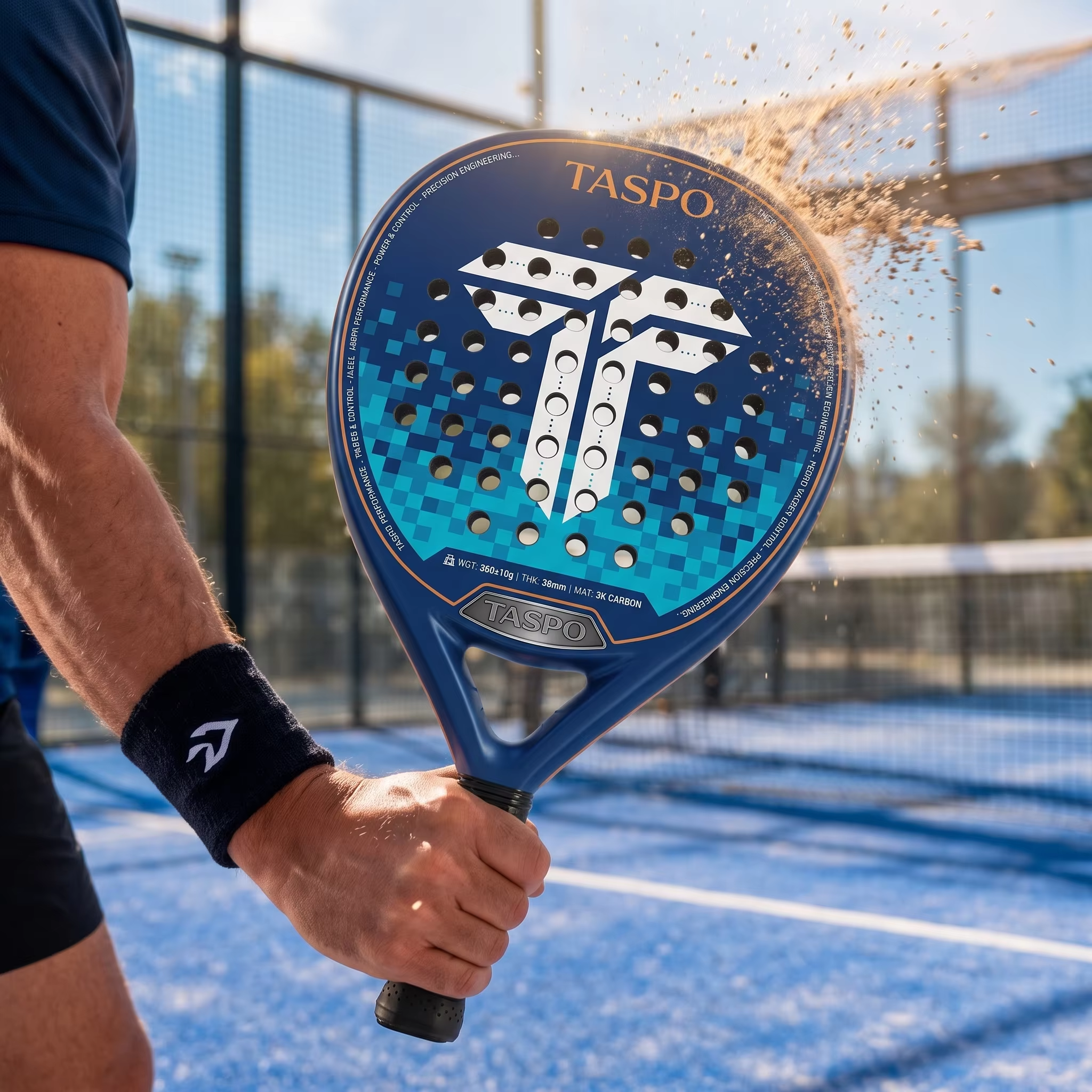
The primary structural skeleton responsible for resisting perimeter twist is the tubular outer rim encircling the foam core. Entry-level and mid-tier recreational paddles are commonly constructed using a hollow single-tube fiberglass rim cured at low atmospheric pressure. Because fiberglass possesses a relatively low tensile modulus and a single thin wall buckles easily under localized shear stress, these frames deform noticeably during heavy blocks and accidental wall scrapes. Conversely, tournament-grade padel racket frame rigidity is achieved by engineering a bi-directional twin-tube carbon fiber beam, often reinforced with internal structural carbon ribs along the three-o'clock and nine-o'clock flanks. During manufacturing, two parallel carbon prepreg tubes are wrapped with alternating zero-degree longitudinal fibers and forty-five-degree bias braids before being fused under twelve bar of internal pneumatic pressure. In structural engineering, a dual-chamber box beam exhibits exponentially higher polar moment of inertia than a single hollow tube of equivalent weight. This rigid twin-tube carbon skeleton locks the perimeter geometry in place, ensuring that off-center defensive volleys rebound along the intended target vector without leaking kinetic energy into frame twist.
While the outer perimeter tube controls whole-frame twisting, the tensile stiffness of the flat hitting surface regulates vertical launch angles and pace control. A major frustration for advancing players using soft, flexible fiberglass paddles is the unpredictable "trampoline effect." On slow defensive swings, a flexible face pockets the ball deeply and springs it over the net; however, when the player swings aggressively or blocks a hard-hit smash, the overly flexible skin deforms excessively and catapults the ball wildly toward the back glass fence. Enhancing padel racket control for competitive athletes requires replacing非线性 trampoline bounce with a crisp, linear rebound response. By laminating the hitting face with aerospace-grade 3K or 12K woven carbon fiber—engineered from high-modulus T700 or T800 carbon filaments—engineers create a taut, drum-tight impact plane. Under high-velocity ball collisions, high-modulus carbon fibers resist excessive inward cupping. Because the surface remains flat and stable throughout the four-millisecond contact window, the angle of reflection matches the athlete's wrist orientation with mathematical fidelity, allowing skilled competitors to thread low chiquitas through tight court gaps and place drop shots inches over the net cord.
The third critical zone governing mechanical precision is the longitudinal junction connecting the handle shaft to the lower hoop: the racket throat, or bridge. Even if the upper hoop and carbon face are rock-solid, a weak, unsupported throat acts like a flexible hinge that bends backward whenever an athlete executes an overhead bandeja or flat smash. When the throat hinges backward upon impact and snaps forward milliseconds later, it alters the vertical launch loft unpredictably, causing overheads to sail long into the back mesh. Achieving absolute torsional stability requires applying civil-engineering triangulation principles to the throat bridge mold. Rather than leaving an open, hollow triangle at the heart, elite frames incorporate central vertical struts, X-brace diagonal cross-beams, or flared aerodynamic buttresses that anchor the three-o'clock and nine-o'clock frame walls directly into the octagonal handle spine. Finite element deflection testing proves that a triangulated carbon bridge increases longitudinal bending stiffness by over twenty-eight percent compared to open-throat designs. This structural connection ensures that the handle and hitting head move as a single, unified lever, giving the player instantaneous tactile feedback and pinpoint trajectory command from anywhere on the court.
Translating theoretical stiffness models into a commercially dominant equipment lineup requires world-class composite curing technology and strict resin-ratio discipline. Frame rigidity is not achieved by simply piling on heavy layers of cheap epoxy glue; excess liquid resin actually makes a paddle heavy, brittle, and prone to cracking under thermal stress. True lightweight stiffness comes from curing aerospace prepreg carbon fabrics—where toughened epoxy resin is machine-calibrated to an exact thirty-four percent weight ratio—inside precision-machined steel molds under uniform isothermal heat and high internal bladder pressure. In the global sporting goods manufacturing sector, Taspo Sports stands as an authoritative pioneer in high-rigidity composite racket engineering. Operating sub-zero prepreg cleanrooms, multi-cavity hydraulic presses, digital torque-deflection testing benches, and five-axis CNC machining centers, Taspo Sports engineers tournament weaponry for prestigious international sports brands. Every prototype undergoes calibrated torsional load testing to verify that perimeter flex and throat stiffness match exact player tier specifications before mass production begins. By partnering with a premier custom padel racket manufacturer like Taspo Sports, commercial brands secure uncompromised twin-tube carbon construction, laser-sorted weight consistency, and surgical padel racket control that empowers athletes to dominate championship courts worldwide.
 Hot News
2026-11-20
2026-11-20
2026-11-20
2026-11-20
2026-11-20
2026-11-20
 EN