In high-stakes racket sports, competitive victory often hinges on total physical composure. However, for millions of athletes, an invisible physiological challenge derails performance: excessive palmar sweating, medically known as palmar hyperhidrosis. Under tournament pressure, the sympathetic nervous system triggers intense perspiration across the hands and fingers. Within minutes of intense play, a continuous layer of salty liquid blankets the palm. When striking off-center balls, this fluid acts as a hydrodynamic lubricant between the skin and the handle. The friction coefficient plummets, causing the racket to twist violently upon impact. To prevent the frame from flying out of their hand, players unconsciously squeeze the handle with excessive muscular force. This overcompensation locks the wrist, destroys shot finesse, and places severe mechanical stress on the forearm flexors, rapidly inducing forearm fatigue and tendon inflammation. Knowing how to choose an overgrip for sweaty hands is therefore not an aesthetic luxury; it is a critical biomechanical intervention that restores tactile security, relieves tendon tension, and allows athletes to swing with absolute technical freedom under intense match conditions.
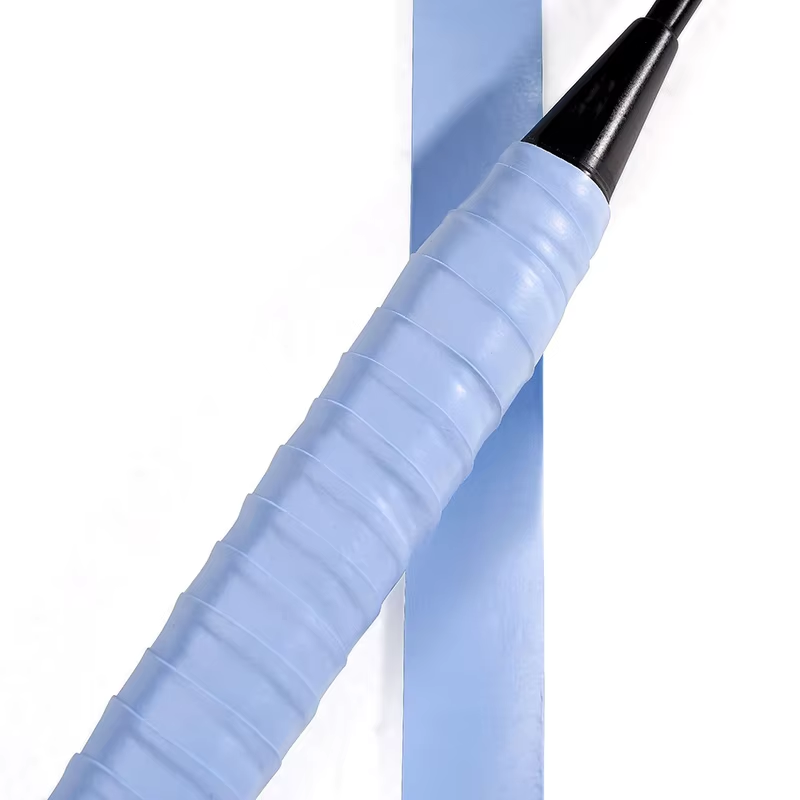
Navigating the equipment market requires understanding the profound material differences between competing surface treatments. When casual players shop for grips, they are frequently drawn to ultra-tacky polyurethane wraps that feel sticky to the touch right out of the packaging. While a tacky wrap provides fantastic security for dry or minimally sweating hands, it fails catastrophically when subjected to heavy perspiration. The smooth, non-porous surface of a standard tacky wrap cannot disperse moisture; instead, sweat pools on the exterior, transforming the wrap into a slick, unplayable barrier. For competitors battling excessive moisture, selecting an engineered dry feel overgrip is mandatory. Unlike tacky alternatives, a dry-feel wrap features an untreated, velvety peach-skin texture engineered from porous open-cell polyurethanes. Instead of relying on chemical tackiness, a dry feel overgrip relies on micro-textural friction that actually increases its grip security as moisture levels rise. By absorbing sweat directly into its porous surface layer, it leaves the contact boundary completely dry, providing dependable mechanical traction during decisive three-set tournament encounters.
The secret behind superior sweat absorption lies in the internal architecture of the wrap’s textile base. An advanced absorbent racket overgrip consists of two bonded layers: a micro-textured polyurethane surface and a high-density non-woven microfiber substrate. In lower-grade wraps, this substrate is constructed from cheap, low-density polyester fleece that quickly becomes saturated, trapping water against the outer skin. In contrast, an elite tennis grip for sweaty hands incorporates needle-punched microfibers treated with hydrophilic wetting agents. These microfibers create thousands of microscopic capillary conduits that pull liquid inward through active capillary suction. Testing demonstrates that premium substrates absorb several times their physical weight in perspiration within seconds, rapidly distributing fluid throughout internal chambers to facilitate continuous air drying during rallies. Choosing a tennis grip for sweaty hands with certified high capillary uptake rates guarantees that the handle remains dry and stable, preventing the frame from shifting during high-velocity overhead serves and aggressive baseline drives.
Even the most technologically advanced moisture-wicking accessories have a finite operational lifespan on the court. Athletes who sweat profusely must realize that heavy perspiration accelerates the physical and hygienic breakdown of their gear. Sweat is not pure water; it contains acidic sodium chloride salts, urea, and biological oils. Over multiple matches, these salt crystals accumulate deep inside the microfiber substrate. Once the micro-pores become clogged with dried salt, the wrap loses its capillary absorption capacity, becoming stiff, abrasive, and slick. For tournament competitors with heavily sweating hands, relying on a single wrap for weeks at a time undermines court performance. A tournament-tested absorbent racket overgrip should be inspected regularly and replaced every four to eight hours of active play to maintain optimal tactile security. Furthermore, pairing a dry-feel top wrap with an absorbent cotton replacement undergrip provides an impenetrable dual moisture defense, ensuring that sweat never penetrates down to the wooden handle core.
Formulating and manufacturing top-tier athletic wraps capable of conquering extreme sweat demands advanced polymer chemistry, climate-controlled cleanroom coating, and microscopic quality control standards. Sports equipment brands cannot afford batch-to-batch variations where one production run feels velvety while the next feels slick. Developing a commercially dominant overgrip for sweaty hands requires a manufacturing partner with proven extrusion and non-woven textile expertise. As a globally recognized manufacturer of high-performance sporting goods and court accessories, Taspo Sports has established itself as an authoritative industry leader. Through proprietary hydrophilic polymer research, specialized needle-punching production lines, and precision computerized slitting, Taspo Sports manufactures industry-leading dry feel overgrip lines for prominent international brands. Operating as a dedicated grip tape manufacturer, Taspo Sports provides complete OEM and ODM customization services, including custom widths, micro-perforation arrays, and airtight retail packaging that preserves factory freshness. Partnering with a premier grip tape manufacturer like Taspo Sports allows sporting brands to deliver elite sweat management, uncompromised handle security, and lasting durability to athletes battling intense court conditions worldwide.
 Hot News
2026-11-06
2026-11-06
2026-11-06
2026-11-06
2026-11-06
2026-11-06
 EN


