 EN



What Defines Pickleball Edge Tape Shock Absorption
Pickleball edge tape can soften contact between a paddle rim and a hard surface, but a soft-looking strip is not proof of effective cushioning. Its response depends on the backing, adhesive, thickness, fit and the force of the impact. When comparing materials, treat shock absorption as a testable property of the taped paddle, not a promise printed on a roll.
This matters whether you are replacing a worn strip or comparing samples for a paddle range. Pickleball edge tape can also shield against scrapes, yet resistance to abrasion and response to a direct impact are different properties. A sample that looks good after rubbing may react differently when struck.
What happens when the paddle edge hits a surface?
During a collision, pickleball edge tape sits between the surface and the paddle's guard or exposed edge. If the backing compresses, it can extend the distance and time over which the contact force acts. Some energy can return as rebound, while some is dissipated within the material. The amount transferred to the paddle depends on the whole contact system, not the tape alone.
Research on polyethylene foam shows that energy absorption changes with compression rate. That observation helps explain why a slow thumb press is not a reliable prediction of a fast court impact. The study does not establish a rating for any particular pickleball edge tape, and a thin strip on a curved guard behaves differently from a foam specimen in a laboratory.
Keep the limits in mind. Pickleball edge tape is a replaceable surface layer, not a repair for a cracked paddle or a guarantee against structural damage. A severe impact can exceed what a thin protective layer can manage.
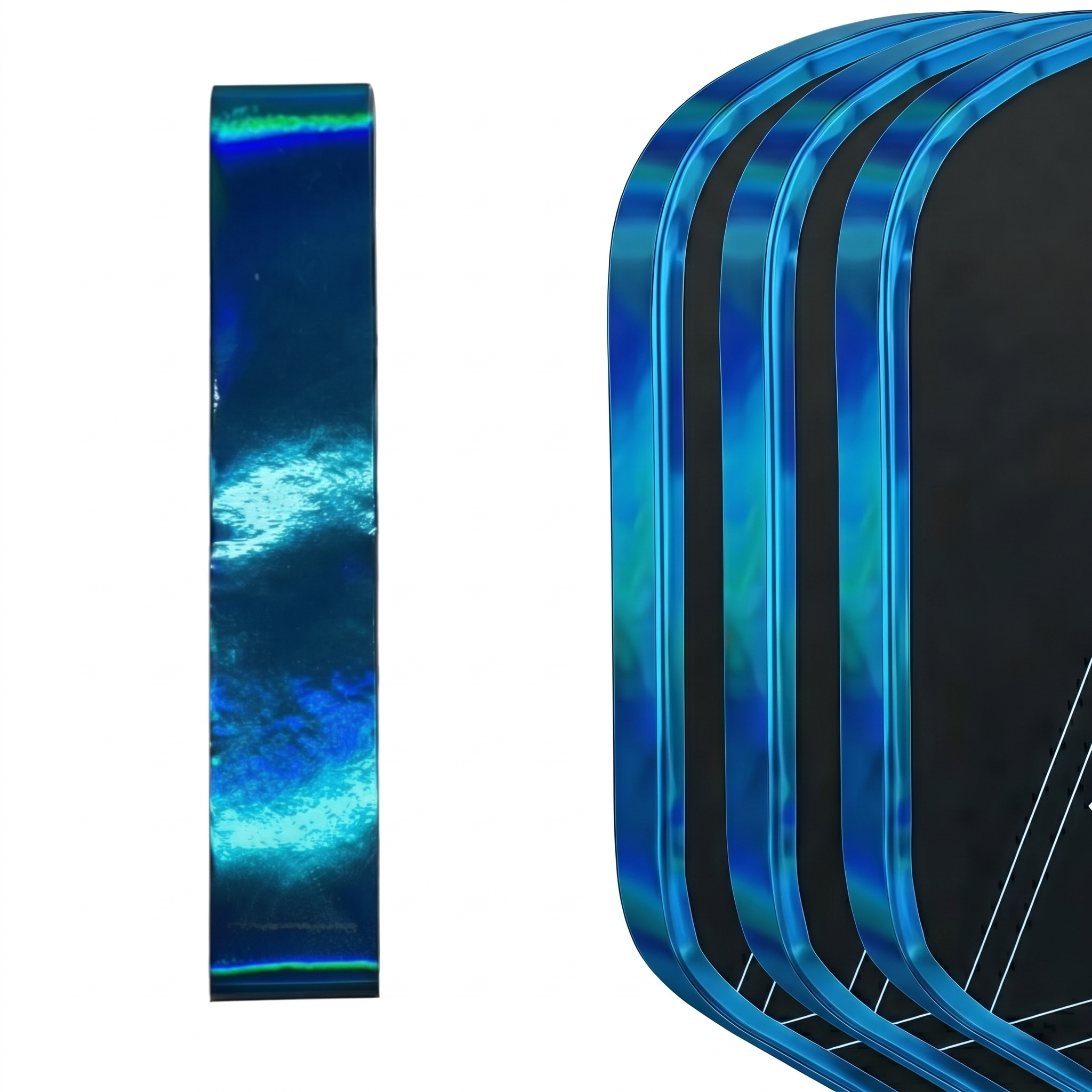
Five factors that shape cushioning
1. Backing material and construction
Pickleball edge tape may use a flexible film, a foam-like backing or multiple layers. A film can offer a sacrificial barrier for scuffing; a compressible layer may change how a local impact is distributed. Neither description is enough to rank products. Ask for the material construction and the test method before comparing claimed impact performance.
Some backings recover quickly after compression; others recover more slowly or retain a dent. Recovery behavior helps describe pickleball edge tape but is not the same as the force transmitted to the paddle. Surface finish, adhesive and support beneath the tape also matter.
2. Thickness and usable compression
More material can provide more room to deform, but thicker pickleball edge tape is not automatically more protective. A very stiff layer may compress little at the force encountered; a very soft one may compress until the guard underneath carries the load. Width and thickness can also change how neatly the strip follows the paddle.
Compare samples at their actual thickness and on the same paddle edge. If pickleball edge tape wrinkles or bridges over a curved rim, its contact area may vary along the edge. A neat fit is a useful starting condition for comparison, not a shock-absorption certificate.
3. Adhesive contact and fit
The adhesive keeps pickleball edge tape in place during handling and contact. A lifted corner can catch or expose part of the guard, while excessive stretching during application can encourage the strip to pull back. Follow the tape and paddle makers' instructions for cleaning, placement and removal; check compatibility on a small area if advised.
A wider strip is not necessarily a better fit. Measure the guard and check how far the pickleball edge tape extends onto each face. Tape that is easy to position without folds makes a more consistent sample for evaluating wear and adhesion.
4. Impact conditions and the paddle beneath
An edge guard, an edgeless rim and different paddle constructions do not provide the same support. Pickleball edge tape is therefore one part of a system. Impact angle, surface hardness, contact area and impact speed can all change the outcome. A comparison on one paddle model cannot automatically be applied to every model.
Temperature and repeated use may change how a material responds. When pickleball edge tape is used outdoors, ask whether the supplier has data under conditions relevant to the intended application rather than assuming a single room-temperature result covers all conditions.
5. Abrasion and repeated contact
For a buyer seeking scratch resistant paddle edge tape, surface wear deserves its own assessment. Rub resistance helps describe how the outer layer handles scraping; it does not quantify impact cushioning. Inspect samples for cuts, lifting and loss of coverage as well as visible marks.
After repeated contact, pickleball edge tape may develop a crease, a dent or an exposed edge. Replace a damaged strip according to the product instructions. If the paddle itself is cracked or the guard is loose, consult its manufacturer rather than covering the damage and assuming it has been addressed.
How to compare samples without overclaiming
Start by defining the failure you want to reduce: superficial abrasion, lifting after play, or force transmitted during a rim impact. Pickleball edge tape may perform differently for each. Use the same paddle model, preparation and placement for every sample so that the comparison is meaningful.
- Record the construction. Ask for backing and adhesive details, nominal thickness, width and lot identification. Confirm whether measurements include the adhesive and liner.
- Request impact data. Ask the supplier for the method, impactor geometry, speed or energy, support surface and number of trials. Peak transmitted force, absorbed energy and rebound are different measurements; do not treat them as interchangeable.
- Check fit and adhesion. Apply each sample to the same rim profile. Note wrinkles, lifted edges and removal behavior using the maker's instructions.
- Assess wear separately. Compare rubbing and edge contact under a documented procedure, then inspect coverage and any damage to the guard.
- Keep the scope clear. A controlled comparison can distinguish the tested samples under stated conditions. It cannot promise protection from every court impact.
For sports equipment edge tape bulk orders, agree on the sample specification and acceptance criteria before ordering. Discuss roll dimensions, backing and adhesive consistency, packaging and lot identification with the supplier. Request the actual terms and documentation for the order; availability and test services should not be assumed.
Application, rules and replacement
Before applying pickleball edge tape, check that the paddle is clean and dry as directed by its maker. Work gradually around the edge without pulling the strip excessively, and press it down evenly. Pay attention to the transition around tight curves and inspect the ends after use. Avoid solvents or heat unless the relevant instructions permit them.
If the paddle is used in sanctioned play, review the current governing body's equipment rules and the event's requirements before adding pickleball edge tape. The 2026 USA Pickleball rulebook addresses adding or replacing edge guard tape, but the applicable restrictions and any later updates still need checking. A tape purchase does not establish tournament eligibility.
In short, pickleball edge tape should be judged by a combination of fit, measured impact response, surface wear and practical adhesion. Compare documented samples on the paddle and under conditions relevant to your use; choose only after the trade-offs are clear.
 Hot News



