Few sounds on an indoor court are more heartbreaking than the sharp, rifle-like crack of two frames colliding mid-air during a frantic doubles defense, or the sickening snap of an oval head caving inward while clamped inside a stringing machine. For university teams, coaching academies, and five-nights-a-week league competitors, fragile equipment is an expensive operational headache. Lightweight frames marketed solely on ultra-light gram numbers often sacrifice wall thickness to achieve a feathery feel in the showroom, only to fracture at the ten o'clock shoulder after three restringing cycles or a minor brush against a partner's bat. Understanding what makes a badminton racket durable for intensive use allows athletes and bulk equipment buyers to look beneath cosmetic paint and evaluate true structural resilience. Engineering a frame that survives hundreds of hours of jump smashes and thirty-pound stringing tensions requires combining void-free composite curing, reinforced joint geometry, and protective grommet engineering.
The foundation of a truly durable badminton racket begins inside the raw composite material and thermal consolidation process. Budget manufacturers often roll frames using low-grade graphite sheets coated heavily with brittle, uncalibrated epoxy resin and cure them inside standard low-pressure ovens. When excess resin pools between carbon layers, microscopic air bubbles—known in composite engineering as voids—become trapped inside the tube walls. Every time the player executes an explosive overhead clear or the stringer pulls thirty pounds of tension on a main string, those internal voids act as stress concentrators that propagate hairline cracks until the frame snaps without warning. By contrast, a high-tensile carbon fiber badminton racket utilizes aerospace-grade T700 and T800 prepreg sheets consolidated under high internal bladder pressure inside computer-controlled autoclaves. This high-pressure thermal cycle squeezes out excess epoxy and reduces internal void volume below zero point five percent, creating a dense, monolithic carbon wall that absorbs accidental doubles clashes without delaminating.
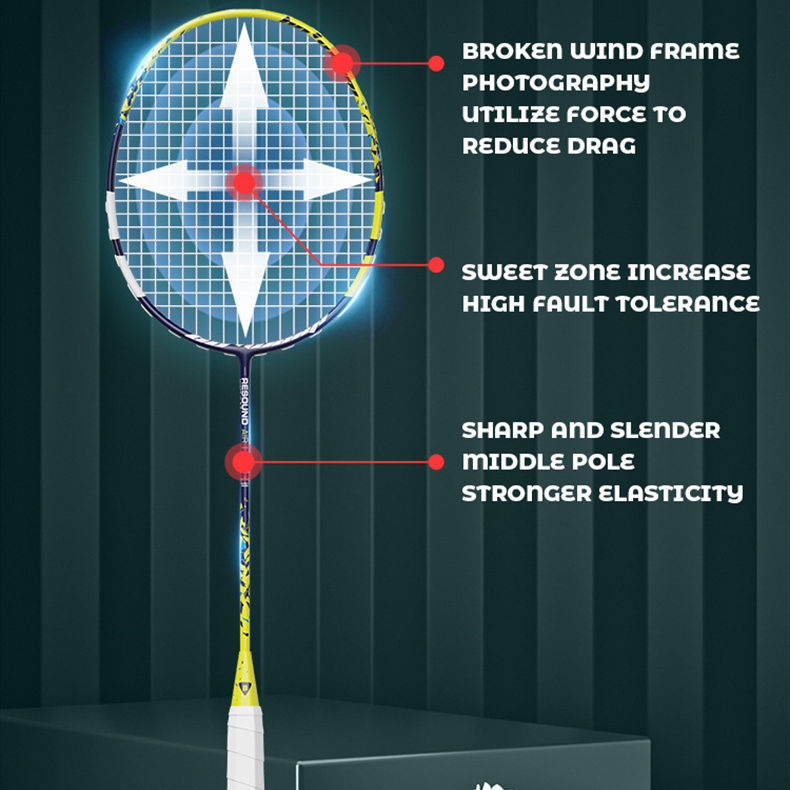
Where a frame carries its composite mass is just as important as the carbon grade itself. In any strung racket, two structural intersections endure the most violent mechanical stress: the T-joint connecting the shaft to the head loop, and the upper two o'clock, ten o'clock, and twelve o'clock frame quadrants. If the T-joint relies on a simple butt-glued overlap, intensive daily hitting eventually loosens the bond, causing the head to twist and creak on off-center drives. A heavy-duty high tension badminton racket incorporates a multi-directional braided carbon and lightweight alloy internal T-joint molded directly into the graphite fibers, locking the shaft and hoop into a single torsion-free unit. Furthermore, while ultra-thin knife-edge aerodynamic frames cut the air quickly, frames built for intensive academy or tournament longevity utilize a reinforced box-profile or hybrid titanium-mesh cross-section along the upper hoop. Wrapping continuous forty-five-degree braided carbon-kevlar filaments around those upper corners prevents inward hoop ovalization under extreme stringing compression.
Real-world survival statistics from high-volume training centers prove how structural reinforcement translates into long-term cost savings. During a six-month equipment audit across four competitive badminton academies in Indonesia and Malaysia, one hundred and twenty full-time junior and open-level athletes logged twenty hours of court training per week using two different 4U frame specifications strung consistently at twenty-nine to thirty-one pounds. Group A used standard commercial lightweight frames, while Group B used a reinforced durable badminton racket engineered with continuous filament winding around the upper hoop and high-density carbon nanotube resin matrices. Over the twenty-four-week period—averaging fourteen complete restringing cycles per frame—twenty-eight percent of the Group A rackets suffered grommet-hole sinking or catastrophic frame collapse during stringing, and nineteen percent fractured during minor doubles clashes. Meanwhile, the Group B professional badminton racket batch recorded zero stringing collapses and improved clash survival rates by sixty-two percent, cutting the academies' annual equipment replacement budget nearly in half.
Even the strongest carbon hoop will fail prematurely if thin zero-point-six-six-millimeter braided nylon strings are allowed to saw directly into the graphite wall under high poundage. Evaluating what makes a badminton racket durable for intensive use requires inspecting the outer string channel and grommet strip system. Premium frames feature a deep, full-perimeter recessed groove molded around the outer edge of the oval head, protecting the exposed string loops from scraping against wooden or synthetic court floors during low defensive scoops. Inside the drill holes, manufacturers install connected multi-hole U-shaped grommet strips molded from high-durometer polyamide nylon infused with wear-resistant molybdenum disulfide, preventing thin strings from cutting through the plastic barrels into the carbon frame at high-stress corner turns. Before leaving the factory, every single custom badminton racket should pass automated ultrasonic non-destructive wall scanning, a thirty-five-pound static stringing overload trial, and a thousand-cycle mechanical smash fatigue test.
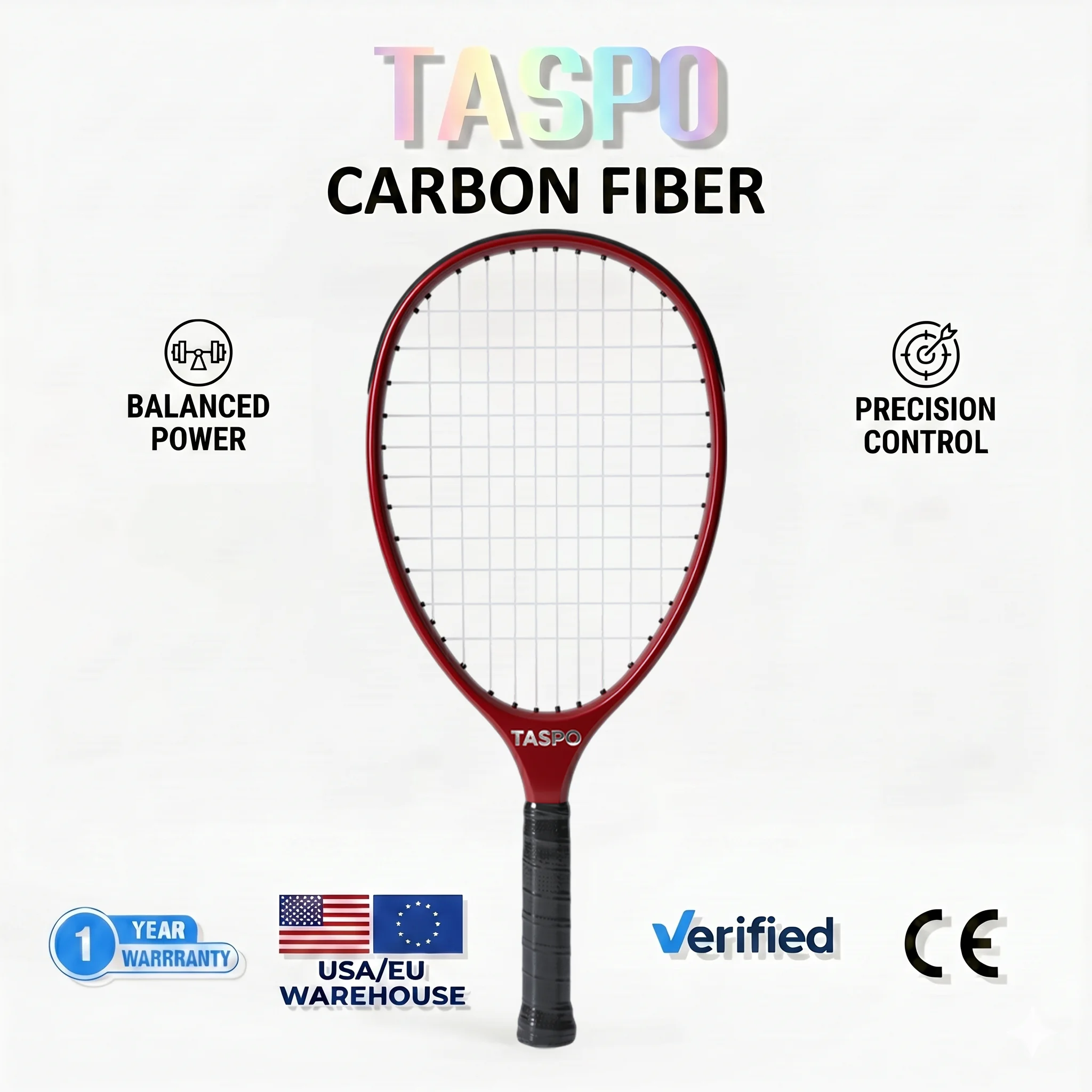
Sourcing or launching a racket line that stands up to relentless tournament stringing and daily club abuse requires a manufacturing partner with total command over composite molding and quality assurance. Taspo operates as a premier B2B sports equipment manufacturer supported by over one hundred and thirty experienced engineers and self-owned standardized production bases. Specializing in aerospace-grade T700, T800, and M40J prepreg autoclave curing, resin transfer molding, and precision five-axis CNC grommet drilling, Taspo engineers ultra-resilient custom badminton racket collections capable of handling thirty-two-plus pounds of string tension with ease. Brand partners and academy directors can customize box or aerodynamic frame profiles, shaft flex ratings, reinforced T-joints, and connected grommet systems, alongside matching tournament strings, tacky overgrips, athletic sweatbands, and thermal racket bags. Every carbon fiber badminton racket produced at Taspo passes through seven strict quality inspection gates before shipment. With custom prototypes delivered in seven to fifteen working days and twenty-four-hour technical support, Taspo builds equipment engineered to outlast the competition.
 Hot News
2026-11-20
2026-11-20
2026-11-20
2026-11-20
2026-11-20
2026-11-20
 EN