When stepping onto a badminton court, even an untrained eye can spot the difference between a lightning-fast defensive block and a devastating jump smash. Behind every dynamic shot lies the hidden science of badminton racket engineering. The physical weight printed on a frame, typically categorized between 3U and 5U, only tells half the story. The true performance characteristic of any racket is governed by how mass is distributed across the frame from the handle to the tip. This distribution dictates the balance point, commonly measured in millimeters from the butt cap. A balance point between 280mm and 290mm yields a head-light configuration, whereas a measurement exceeding 300mm creates a formidable head heavy badminton racket. This geometric mass allocation fundamentally alters the swing weight, which represents the dynamic inertia experienced by the player during a swing. In competitive play, swing weight determines how quickly an athlete can accelerate the racket head through the contact zone. Understanding badminton racket weight distribution is crucial because two frames with the identical static weight of 85 grams can feel completely different in motion. If the majority of mass is concentrated in the racket head, the rotational inertia increases substantially, demanding greater muscular effort to initiate and decelerate swings while delivering immense kinetic momentum at impact.
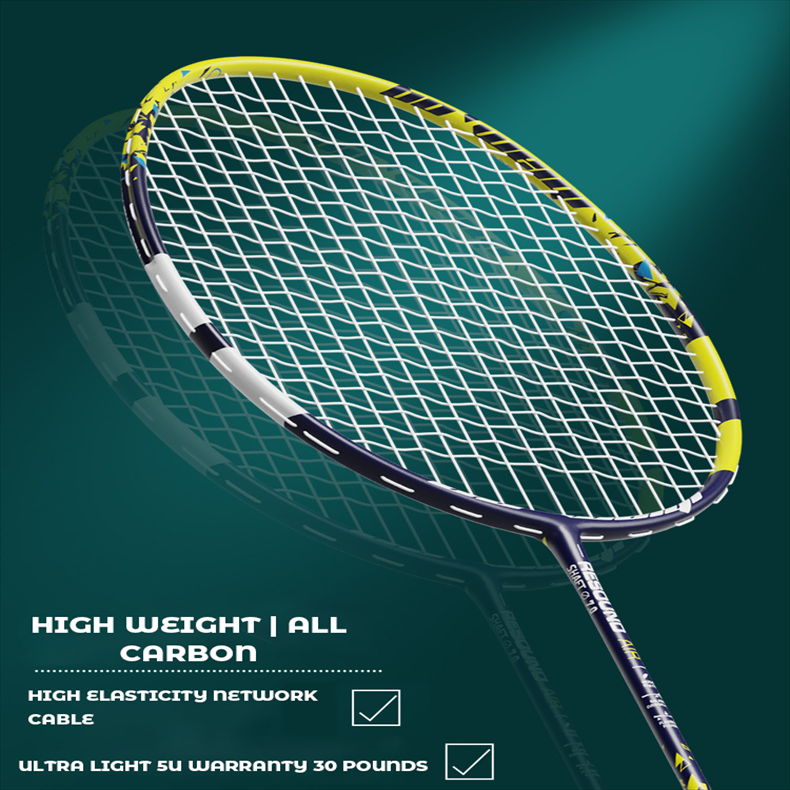
In modern badminton, rally tempo has accelerated to unprecedented levels, making maneuverability a deciding factor in extended tournament matches. When players engage in rapid flat drives across the net, reaction windows shrink to milliseconds. A poorly engineered frame with awkward badminton racket weight distribution forces the player to overcompensate with forearm and wrist torque. This excessive strain quickly leads to muscular fatigue and compromises shot precision. Utilizing a balanced or head-light setup allows athletes to recover their defensive stance rapidly, which is why mixed doubles front-court specialists often favor maneuverable frames. Conversely, singles players who rely on baseline dominance frequently demand a head heavy badminton racket to punch clears deep into the opposing court with minimal effort. However, if a heavy-headed frame lacks aerodynamic optimization, it creates excessive drag that slows down swing speed. True mastery in badminton racket engineering lies in harmonizing mass placement with streamlined frame profiles, such as sword-blade or box-frame contours. By fine-tuning these structural elements, engineers can eliminate the sluggish feel often associated with power-oriented rackets, allowing players to swing aggressively throughout grueling three-set matches without suffering from premature grip exhaustion.
The transition from traditional aluminum and steel frames to aerospace-grade composite materials has revolutionized badminton racket engineering. Modern manufacturers do not simply add lead tape or heavy grommets to adjust balance; they strategically map carbon fiber prepreg layers throughout the shaft and head. High-modulus carbon fibers, rated at 40T and above, provide extraordinary tensile strength while allowing designers to shave weight from non-critical areas. By reducing mass along the throat and T-joint, engineers can relocate structural density directly into the upper perimeter of the frame. This precise badminton racket weight distribution alters the moment of inertia, significantly expanding the sweet spot and preventing torsional twisting during off-center hits. When a player unleashes a high-velocity overhead stroke with a head heavy badminton racket, the specialized carbon layup flexes and snaps back with explosive recoil. Nanomaterials infused into the resin matrix further enhance stress dissipation, ensuring that the kinetic energy generated from the body moves uninterrupted into the shuttlecock. This sophisticated integration of material science and mass positioning ensures that every gram contributes directly to stability, flex response, and structural longevity.
Laboratory simulation and court testing provide undeniable empirical proof of why badminton racket weight distribution matters so intensely. High-speed optical tracking cameras operating at 2000 frames per second demonstrate that shuttlecock release velocity is directly correlated to the dynamic mass behind the impact point. In controlled testing environments, an optimized head heavy badminton racket consistently produces terminal smash velocities exceeding 400 kilometers per hour, outperforming evenly balanced alternatives by noticeable margins. However, launch speed is only one variable in elite athletic competition. Advanced sensor telemetry attached to player handles reveals that erratic weight profiling produces erratic vibration resonance. When mass is improperly distributed, high-frequency shockwaves travel down the carbon shaft and shock the wrist and elbow joints upon impact. Modern badminton racket engineering utilizes laser-guided balance calibration and digital frequency analyzers to map vibration dissipation across the entire frame. This data-driven validation ensures that frames deliver optimal smash power while maintaining a clean, muted feel at contact, shielding competitive players from cumulative stress injuries over long seasons.
Translating complex weight physics into mass-market athletic equipment requires exceptional manufacturing discipline and uncompromising quality control. In the competitive sports equipment industry, global brands cannot afford batch-to-batch variations where one frame feels head-heavy while another feels head-light. Achieving consistent badminton racket weight distribution requires precision tooling, automated prepreg wrapping, and strict weight-matching protocols that hold tolerances to within plus or minus one gram. As an elite manufacturer in high-performance sporting goods, Taspo Sports has set the standard for advanced badminton racket engineering. Utilizing state-of-the-art carbon molding technology, specialized autoclave curing, and multi-axis CNC finishing, Taspo Sports delivers custom OEM and ODM solutions tailored to the exacting specifications of international brands. Whether engineering an agile, defensive racket or designing an ultra-powerful head heavy badminton racket for world-class tournament play, Taspo Sports ensures that every finished product exemplifies world-class balance, unmatched torsional stability, and outstanding structural integrity.
 Hot News
2026-11-06
2026-11-06
2026-11-06
2026-11-06
2026-11-06
2026-11-06
 EN


