 EN


How Custom Badminton Racket Designs Fit Brand Requirements
A custom badminton racket is not just a surface for a logo. For a brand team, it is a compact product decision that must connect a target player, a price position, a visual system, and a repeatable approval process. The most useful starting point is not “Which color should we use?” but “Who is this racket for, and what must the finished product communicate?”
From a brand-product-manager perspective, a brief is clearer when it separates what the brand wants to achieve from what the factory needs to verify. That distinction is especially important for a high tension frame badminton racket OEM project: a high-tension message can affect the frame brief, stringing plan, labeling, testing discussion, and customer expectations. It is not a generic performance promise.
Start with the brand role of the badminton racket
Before choosing materials, weight classes, or paint treatments, define the racket’s role in the range. A value-focused club model, a training-oriented model, and a competition-positioned model may all carry the same brand, yet need different messages and approval criteria. This is where a project often shifts from looking first at appearance to confirming the intended player and channel.
- Target user: Is the product aimed at entry-level recreational players, committed club players, or a specialist audience that already understands specifications?
- Range position: Will the model be an accessible entry point, a mid-range upgrade, or a halo product for a focused collection?
- Sales channel: Retail, distributor, school/club supply, and direct online sales each need different packaging information and merchandising support.
- Brand signal: Decide whether the visual language should emphasize durability, speed, precision, heritage, or a limited-edition story—then make sure the technical brief can support that signal.
Making these choices early reduces rework. A graphic that suits a youthful retail line can still be inappropriate for a premium club program if the naming, finish, and specification communication do not align.
Turn the brand brief into design decisions
Once the audience is clear, turn broad preferences into items a supplier can quote, sample, and check. A custom badminton racket brief commonly groups decisions into four connected areas.
1. Frame and shaft conversation
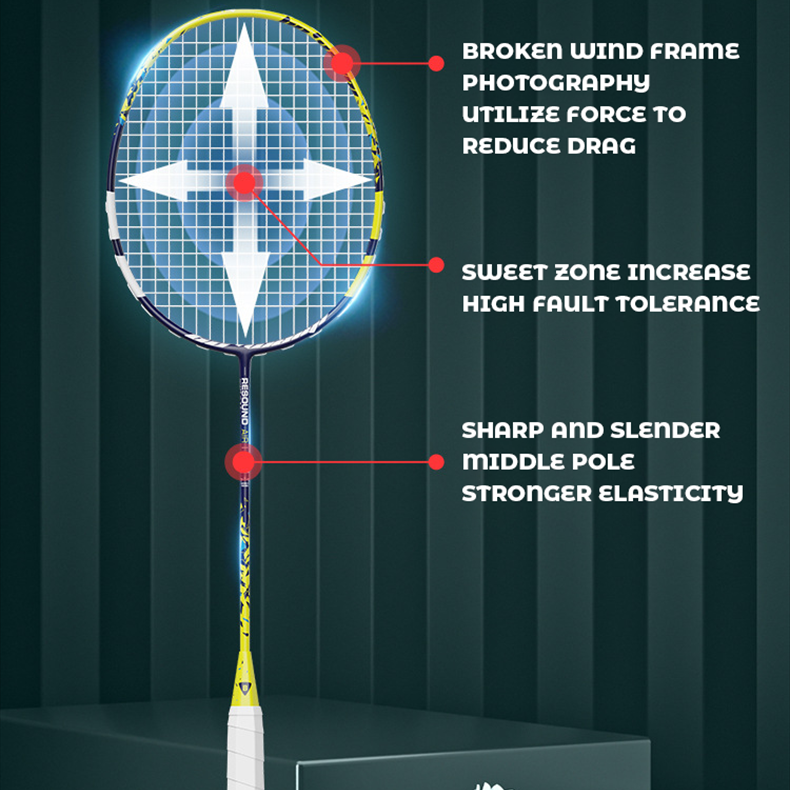
Ask for the frame geometry, shaft feel category, balance target, weight class, grip size, and stated stringing limit as separate fields. These fields should be confirmed in the factory’s technical documentation rather than inferred from a paint concept or a material name. If competition-oriented positioning matters, the current BWF Laws set an outside envelope for a racket frame of no more than 680 mm overall length and 230 mm overall width. That is a regulatory boundary to verify against the applicable version of the rules, not a substitute for a complete product specification.
For a high-tension concept, ask the OEM to state what is being tested, which stringing method is assumed, and how the maximum tension will be marked. Frame behavior can depend on the construction, grommet layout, string pattern, string type, and stringing process. A label should communicate a confirmed limit; it should not turn an unvalidated marketing phrase into a warranty exposure.
2. Visual identity and finish
Artwork is where a brand can create clear family recognition, but it should arrive in an approval-ready package: color references, logo placement, finish direction, decal boundaries, and version control. Consider how the design reads at normal retail distance and in product photography, not only on a digital render. Keep any claims on the shaft, cone, packaging, and hangtag aligned. If the product is sold across several markets, reserve a review step for language, symbols, and required local information.
3. Packaging and product story
The packaging should help a buyer understand the model’s intended use without making unproven claims. Useful, checkable information can include model name, weight or grip options if confirmed, care guidance, the stated tension limit if approved, and the intended player profile. Avoid writing “more power,” “injury prevention,” or tournament eligibility unless the brand has the evidence and authorization needed for those claims.
4. Quantity and assortment planning
A high tension badminton racket bulk order needs an assortment plan as much as a design plan. Decide whether the order is one model with multiple cosmetic variants, several weight/grip combinations, or a small launch range. Each added variant affects artwork control, labeling, sample approvals, inventory forecasting, and the chance of mixing specifications. In a first production run, a tighter assortment can make approvals easier to trace.
Use a requirements matrix before sampling
Instead of passing a loose collection of messages and images, organize the project in a simple matrix. It gives the brand, purchasing contact, and factory one shared reference.
| Brand requirement | Design input to confirm | Evidence or approval gate |
|---|---|---|
| Clear player positioning | Target user, use context, range tier | Approved product brief and copy hierarchy |
| High-tension positioning | Frame specification, string pattern, stated limit, marking location | Factory confirmation and agreed test/sample review plan |
| Recognizable identity | Color references, logos, finishes, decal layout | Artwork proof and physical/color sample approval |
| Consistent retail communication | Packaging copy, icons, care information, SKU logic | Pre-production packaging proof |
| Scalable bulk purchase | Variant count, quantities by SKU, carton labeling | Purchase order and pre-shipment checklist |
The matrix also makes it easier to distinguish a “must-have” from a “nice-to-have.” For example, a confirmed tension marking may be essential to a high-tension product position, while a special finish may remain optional until cost and sample timing are clear.
What to ask a high tension frame badminton racket OEM
Supplier discussions are more productive when questions are specific and testable. Rather than asking whether a badminton racket is “professional,” ask how the product will be documented and verified for the intended range position.
- What frame, shaft, grommet, and string-pattern details can be recorded in the specification sheet?
- What maximum stringing limit can the factory formally state for the proposed configuration, and where will it be marked?
- What sample stages are available: artwork proof, color/finish sample, structural sample, and pre-production sample?
- What changes after artwork approval would require a new sample or revised lead time?
- How will SKU labels, cartons, and inspection records distinguish grip, weight, and cosmetic variants?
These questions do not assume a particular factory capability. They create a disciplined way to compare responses and prevent the brand story from getting ahead of the validation record.
Build approval gates into a bulk order
For a high tension badminton racket bulk program, approval gates protect both the brand and the supplier. A practical sequence is: approve the written brief; approve artwork and labeling language; review the relevant samples; lock the SKU and quantity breakdown; then agree on production and inspection checkpoints. If a change appears after sample approval—such as a new logo size, alternate grip, or revised tension statement—record it as a controlled revision rather than relying on chat history.
This process also supports better downstream communication. Sales teams can use approved, conditional language; distributors can receive consistent SKU information; and customer-service teams can find the confirmed care and specification details. The goal is not to overload a badminton racket with claims. It is to give every visible claim a documented basis.
Make the design brief a brand asset
The strongest custom badminton racket projects use design as a bridge between brand strategy and production control. Start with player and channel intent, map that intent to choices the factory can confirm, and keep high-tension positioning tied to evidence, labeling, and sample review. With that sequence, a custom design can look distinctive while remaining easier to source, explain, and scale.
Before requesting a quote, prepare one final checklist: target user, range role, artwork files, approved copy, required variants, stated specifications to verify, sample criteria, and the person authorized to sign off. It is a small discipline that can make a complex OEM conversation much clearer.


 Hot News


