In competitive lawn tennis, every ounce of kinetic force generated by the legs and core must pass through a single structural bottleneck: the physical connection between the athlete's palm and the octagonal handle shaft. While marketing campaigns routinely spotlight aerodynamic hoop beams and exotic string beds, experienced racquet technicians know that improper grip sizing destroys stroke mechanics faster than any other equipment flaw. Understanding how tennis racket grip customization enhances on-court comfort and shot precision begins with human hand anthropometrics. Standard adult handles are categorized globally from Grip 1 (measuring 4 1/8 inches or 105 millimeters in circumference) up to Grip 5 (measuring 4 5/8 inches or 117 millimeters). When an athlete wields a handle that is too small for their finger length, the thumb and middle finger overlap excessively. To prevent the frame from twisting during off-center baseline returns, the player must squeeze the small shaft with nearly double the necessary muscular force, placing chronic strain on the forearm flexor and extensor tendons. Conversely, an overly thick grip restricts wrist pronation during serves and whip-fast forehands. Calibrating exact circumference tolerances within half a millimeter ensures optimal custom tennis racket ergonomics, allowing the hand to remain relaxed between shots while maintaining total rotational command.
Beneath the outer leather or synthetic wrap, the structural method used to form the octagonal handle shape dictates both tactile feedback and manufacturing flexibility. Across the professional manufacturing industry, engineers utilize two primary architectures: direct in-mold polyurethane foam casting or modular interchangeable handle pallets. In traditional direct-molding, liquid polyurethane is injected directly around the raw carbon graphite hairpin inside a fixed steel cavity. While solid, a direct-molded handle permanently locks the frame into a single grip size; if a retail distributor runs out of Grip 3 inventory while holding excess Grip 2 stock, those frames cannot be resized accurately without altering balance points. Consequently, premier brands increasingly specify a modular tennis handle pallet system. In this advanced design, the raw carbon hairpin is molded to a uniform master dimension, and two precision-machined, high-density polyurethane shells—known as pallets—are bonded around the shaft. Because each pallet size is engineered with adjusted internal wall density, a brand or pro-shop technician can swap a frame from Grip 2 to Grip 4 in minutes while keeping total static weight and longitudinal balance identical.
Beyond simple circumference measurements, the geometric cross-section of the eight handle bevels plays a profound role in how an athlete indexes the string bed angle blindly. Not all octagonal handles share the same dimensional ratios; in fact, touring professionals frequently refuse to switch equipment sponsors unless the new manufacturer replicates their accustomed bevel geometry. Through bespoke tennis racket grip customization, product developers typically engineer two distinct pallet cross-sections: rectangular tour profiles and symmetrical octagonal speed profiles. A rectangular profile elongates the top and bottom bevels (bevels one and five) relative to the side flanks. This flatter shape favours traditional continental and eastern grip players who drive flat through the ball and volley frequently, as the wide side plane locks firmly against the heel of the palm. Conversely, modern baseline grinders who utilize extreme semi-western or full-western grips to brush violently up the back of the ball prefer a squarer, more symmetrical octagonal profile. Equalized bevel widths allow the palm to rotate smoothly around the handle axis without catching on sharp corners, preventing painful calluses across the base of the index finger and thumb.
Achieving world-class custom tennis racket ergonomics requires harmonizing internal vibration isolation with exterior wrap chemistry. When a heavy felt ball strikes near the upper hoop of a stiff graphite frame at over a hundred miles per hour, high-frequency harmonic shockwaves race down the hairpin shaft. To prevent these destructive frequencies from shocking the wrist cartilage, authoritative manufacturers integrate viscoelastic dampening layers directly into the handle assembly. Before attaching the outer tennis handle pallet, technicians wrap the raw carbon hairpin in a thin isolating sleeve of vulcanized elastomer or braided basalt fiber, and inject closed-cell foam inside the hollow twin-tube channels. At the bottom of the handle, the flared butt cap is engineered with an internal silicone gel chamber and a smooth ergonomic trapdoor that allows pro-stock technicians to fine-tune tail weight with tungsten putty. Over the pallet, the choice of base replacement grip defines the final tactile personality. Touring pros who demand maximum bevel sharpness specify genuine vegetable-tanned calfskin leather base grips, whereas club competitors seeking extra joint cushioning opt for multi-layer polyurethane replacement grips featuring laser-perforated moisture channels and high-tack surface coatings.
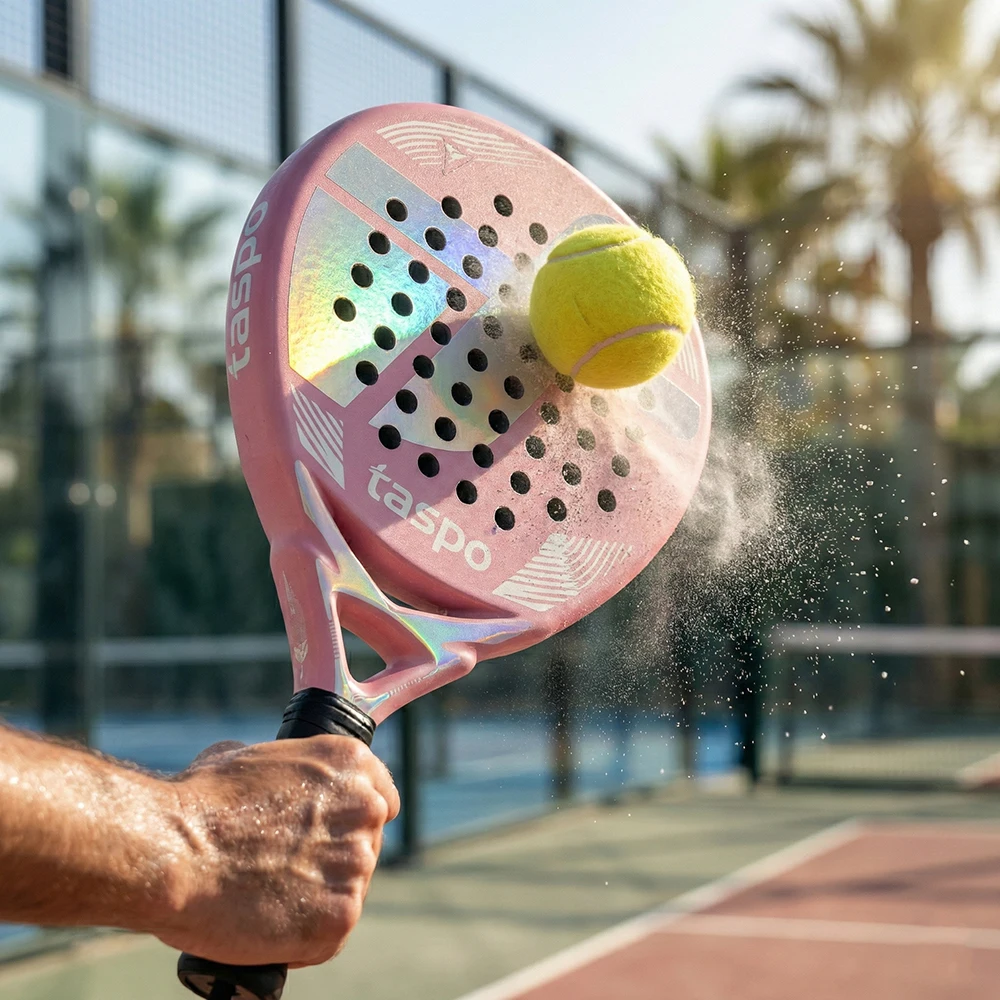
For international tennis brands, elite coaching academies, and specialized retail distributors, handle consistency is the ultimate indicator of manufacturing pedigree. Nothing alienates a discerning player faster than buying two supposedly identical Grip 3 frames, only to discover that one feels noticeably thicker or has rounded, indistinct bevel edges due to sloppy manual sanding. Delivering pro-stock handle precision across commercial production runs requires automated CNC hairpin calibration and high-pressure precision pallet molding. In the global sporting goods industry, Taspo Sports stands as an authoritative leader in advanced carbon composite racquet engineering. Operating sub-zero prepreg cleanrooms, precision bladder-molding presses, automated handle-foaming lines, and laser-guided grip circumference gauges, Taspo Sports manufactures world-class weaponry for ambitious international brands. Whether a client wants to tool a proprietary rectangular or symmetrical tennis handle pallet system, integrate viscoelastic silicone shaft isolation, or customize debossed leather and synthetic base grips, Taspo Sports delivers turnkey OEM and ODM execution. Partnering with an established custom tennis racket manufacturer like Taspo Sports guarantees commercial brands microscopic bevel accuracy, joint-friendly shock filtration, and championship ergonomics on courts worldwide.
 Hot News
2026-11-20
2026-11-20
2026-11-20
2026-11-20
2026-11-20
2026-11-20
 EN