As enclosed glass courts multiply across metropolitan centers and coastal resorts worldwide, the environmental footprint of consumable court equipment has moved to the forefront of industry discussions. Unlike carbon composite paddles that serve an athlete faithfully for a year or more, pressurized spheres are short-lived consumables. Because internal nitrogen pressure slowly diffuses through elastomeric walls and abrasive silica-sand turf shears away exterior nap, millions of discarded spheres end up in municipal landfills every season. Traditional synthetic rubber bladders take decades to decompose, while conventional plastic packaging tubes add substantially to club waste streams. Today, tournament organizers, municipal sports federations, and environmentally conscious athletes are actively demanding an eco friendly padel ball that reconciles championship playability with planetary responsibility. Forward-thinking equipment brands recognize that sustainability is no longer a niche marketing angle; it is a core commercial requirement for securing retail distribution across European and North American pro shops. Developing next-generation sustainable court spheres requires re-engineering every layer of the product—from bio-based elastomer cores and recycled textile coverings to circular packaging architectures.
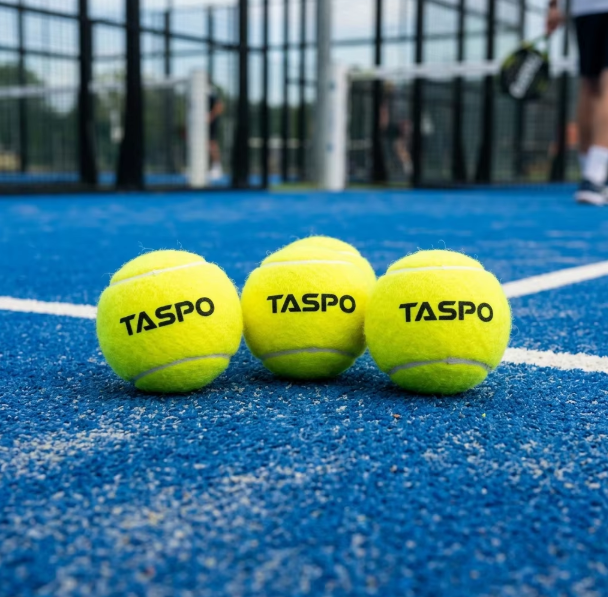
The primary technical hurdle in engineering a sustainable padel ball is reformulating the pressurized internal rubber core without sacrificing rebound liveliness or gas retention. Standard budget factories rely heavily on virgin petroleum-derived styrene-butadiene elastomers mixed with toxic aromatic processing oils. In contrast, modern green material science focuses on two breakthrough pathways: certified bio-based natural rubber and mechanically de-vulcanized reclaimed rubber. By sourcing sustainable natural rubber harvested from Forest Stewardship Council (FSC) certified plantations, chemical engineers replace fossil-fuel polymers with renewable cis-1,4-polyisoprene tree latex. Even more exciting is the integration of closed-loop post-consumer court spheres that have been ground into micronized rubber powder and subjected to ultrasonic de-vulcanization. By breaking the old sulfur cross-links without severing the primary polymer backbone, manufacturers can blend up to thirty-five percent recycled rubber core material back into virgin natural latex batches. Reinforced with natural nano-cellulose fibers and non-toxic zinc oxide activators, this green hybrid bladder passes official Stevens compression deformation audits and delivers the exact same 135-to-145-centimeter granite rebound height as conventional tour spheres.
While the internal rubber core governs bounce mechanics, the exterior cloth covering presents an equally critical environmental challenge. During an intense ninety-minute match on sandy artificial turf, friction shears microscopic synthetic fibers off the sphere's surface. On conventional spheres wrapped in virgin petrochemical nylon and polyester blends, this shedding releases non-biodegradable microplastics across outdoor courts. Future innovations in eco friendly padel ball engineering address textile pollution by restructuring the woven felt matrix. Leading textile mills now spin high-tenacity interlocking yarns from post-consumer recycled polyethylene terephthalate (rPET) reclaimed from ocean-bound plastic bottles, blending them with ethically sheared, biodegradable New Zealand sheep wool. Furthermore, biodegradable cellulosic fibers derived from eucalyptus pulp—commonly known as lyocell—are increasingly tested as eco-conscious synthetic replacements that offer exceptional abrasion resistance against quartz sand. Equally transformative is the elimination of volatile organic compounds (VOCs) on the factory assembly line. By replacing toxic solvent-based toluene rubber cements with zero-VOC, water-based natural latex adhesives to bond the dog-bone felt panels onto the core, manufacturers protect factory workers and eliminate chemical off-gassing when players pop open a fresh tube.
True circularity in court sports extends beyond raw material sourcing to encompass product lifespan extension and zero-waste packaging engineering. Historically, club players discarded spheres after just two or three matches simply because internal gauge pressure dropped from eleven pounds per square inch down to eight PSI, even though the exterior wool felt remained fifty percent intact. Modern eco friendly padel ball initiatives engineer the rubber wall and butyl barrier layer specifically to pair with club-level pneumatic repressurization canisters. When stored inside a fourteen-PSI repressurizing charger tube between weekly matches, spheres recover their original internal atmosphere via reverse transmembrane diffusion, tripling their usable court lifespan from two matches to over seven matches. Simultaneously, the disposable packaging tube itself is undergoing a green revolution. Brands are phasing out virgin PVC cylinders in favor of one-hundred-percent recycled post-consumer PET tubes featuring easily separable polypropylene lids, or pioneering pressurized cardboard canisters lined with ultra-thin plant-based barrier films. Designing biodegradable felt and fully recyclable tubes allows multi-court club operators to place dedicated collection bins courtside, turning dead spheres and empty tubes into closed-loop industrial feedstock.
For international sporting goods brands, retail chains, and corporate tournament sponsors, launching a credible green equipment line requires partnering with an industrial manufacturer that practices verifiable environmental stewardship. Consumers and regulatory bodies quickly penalize vague "greenwashing" claims that lack laboratory proof or certified supply chain traceability. Mass-producing a tournament-legal sustainable padel ball demands solar-powered isothermal vulcanizing presses, closed-loop water filtration systems, and strict ISO environmental management standards. In the global sporting goods manufacturing sector, Taspo Sports stands at the forefront of eco-conscious composite and pneumatic ball engineering. Operating state-of-the-art internal Banbury mixers, solvent-free water-based felt bonding lines, and automated nitrogen canning tunnels, Taspo Sports empowers ambitious brands to pioneer sustainable court collections without compromising a single millimeter of bounce consistency. Whether a business seeks to formulate a recycled rubber core specification, integrate rPET woven wool felt, or package spheres inside 100% recycled PET pressurized tubes, Taspo Sports provides turnkey OEM and ODM execution. Partnering with a forward-looking padel ball manufacturer like Taspo Sports guarantees commercial brands certified environmental compliance, multi-match durability, and championship performance that leads the future of green sports worldwide.
 Hot News
2026-11-23
2026-11-23
2026-11-23
2026-11-23
2026-11-23
2026-11-23
 EN