Spend ten minutes talking to tournament referees or pro shop warranty managers, and a familiar complaint surfaces immediately: modern power paddles breaking down prematurely under heavy hitting. Competitive athletes invest over two hundred dollars in a flagship frame, only to hear a hollow, crunching sound emanating from the sweet spot three weeks later as the internal honeycomb cells collapse or the carbon face delaminates from the core. Even worse, when a player orders a replacement frame of the exact same model, it often swings ten grams heavier and feels completely dead near the upper corners. Understanding how manufacturing standards elevate pickleball paddle performance reveals why two paddles that look identical on a spec sheet behave worlds apart during a third-set tiebreak. True court dominance is not created by marketing buzzwords; it is forged through disciplined thermal curing cycles, micron-level resin control, and uncompromising factory quality assurance.
The biggest leap in pickleball paddle manufacturing over the past decade centers on how composite skins are bonded to cellular cores. Legacy production lines relied on cold-pressing or low-temperature ambient gluing: workers brushed liquid epoxy manually onto a polypropylene honeycomb sheet, laid precut fiberglass or carbon sheets on top, clamped the sandwich at room temperature, and snapped a plastic edge guard around the raw perimeter. Because hand-rolled glue pools unevenly, cold-pressed frames suffer from heavy dead spots, weak perimeter joints, and rapid core fatigue. Modern high-standard pickleball paddle manufacturing replaces that rudimentary assembly with high-temperature, high-pressure unibody thermoforming. Inside precision CNC-machined aluminum molds heated above one hundred and forty degrees Celsius, pre-impregnated carbon fiber wraps continuously around the entire perimeter of the paddle and down through the handle shaft. Injecting expandable high-density foam into the perimeter channel during this thermal cycle fuses the face, edge wall, and handle into a single monolithic chassis that resists torsional twisting and expands the usable sweet spot right to the outer rim.
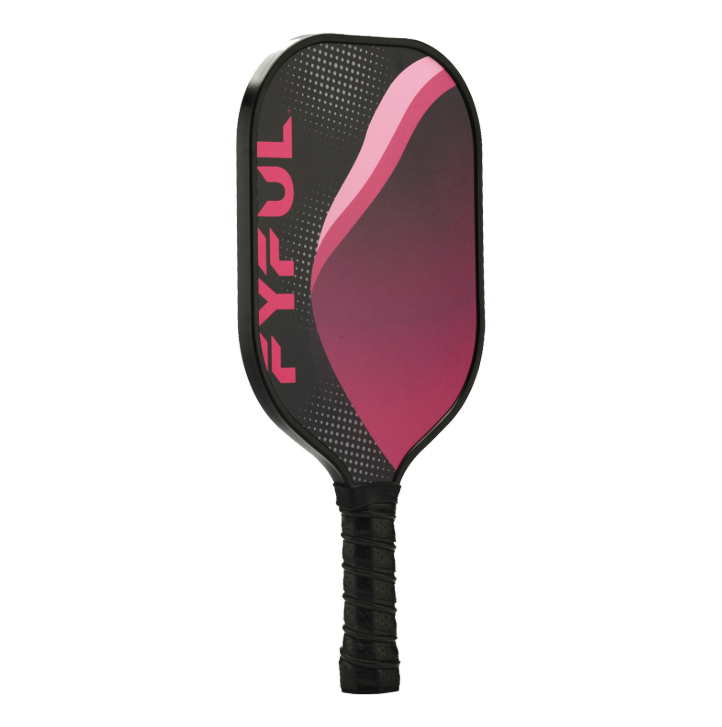
Inside a thermoformed mold, raw material grading dictates how efficiently a carbon fiber pickleball paddle converts swing speed into ball velocity and spin. Rather than using dry commercial carbon cloth soaked in cheap polyester resin, elite manufacturing standards specify aerospace-grade T700 or T800 unidirectional and woven carbon prepreg sheets where epoxy resin content is machine-calibrated to a precise thirty-five percent weight ratio. Engineers orient three to four distinct plies at alternating zero-degree, forty-five-degree, and ninety-degree angles across the hitting surface. This multi-axial architecture allows the face to flex inward like a trampoline for four milliseconds of ball dwell time before snapping back without structural deformation. Beneath those carbon skins sits a virgin polypropylene honeycomb core engineered with compact eight-millimeter cell diameters and reinforced cell wall thickness. Pairing high-density eight-millimeter honeycomb cells with uniform prepreg tension prevents cell wall buckling under seventy-mile-per-hour overhead smashes, eliminating the root cause of core crushing.
Controlled laboratory telemetry proves how disciplined curing protocols directly improve spin longevity on court. To generate heavy topspin on baseline drives and sharp bite on kitchen dinks, manufacturers cure a specialized woven peel-ply release fabric directly against the top T700 carbon layer during hot-pressing; stripping that fabric away after curing leaves a permanent, micro-textured grid forged into the epoxy matrix itself. During a three-month durability study, equipment engineers tested two batches of sixteen-millimeter custom pickleball paddles across five thousand high-velocity ball impacts using a pneumatic cannon. Batch A was rushed through short forty-minute oven cycles with spray-on surface grit, while Batch B followed strict two-hour stepped thermal curing curves with integral peel-ply texturing. High-speed Doppler radar tracking showed that Batch A lost thirty-eight percent of its initial revolutions-per-minute spin rate after just forty hours of play as the sprayed grit wore smooth. Meanwhile, the precision-cured Batch B tournament pickleball paddle retained ninety-one percent of its initial two-thousand-one-hundred-RPM spin generation through the entire two-hundred-hour test window.
Elevating on-court performance also requires keeping every single frame strictly within official sanctioning boundaries while eliminating batch-to-batch variance. Under USA Pickleball equipment regulations, surface roughness must not exceed thirty micrometers on average peak-to-valley star readings or forty micrometers on maximum height audits, and the deflection test must pass strict trampoline limits so paddles remain legal for sanctioned competition. A top-tier factory integrates digital profilometers, automated static load deflectometers, and ultrasonic non-destructive scanners directly into the assembly line. Ultrasonic scanning sends sound waves through every finished carbon fiber pickleball paddle to detect microscopic internal resin voids or unbonded honeycomb cells before cosmetic graphics are applied. Furthermore, weighing raw cores and carbon plies at every workstation keeps finished paddle static weight within a tight plus or minus two-gram tolerance, ensuring that when an athlete switches to a backup frame mid-match, their hand speed and timing remain locked in.
Building a trusted pickleball brand in an increasingly crowded marketplace requires a manufacturing partner that treats composite engineering as an exact science. Taspo operates as a premier B2B sports equipment manufacturer supported by over one hundred and thirty experienced engineers and self-owned standardized production bases. Specializing in advanced T700, 3K, 12K, and 18K carbon fiber prepreg layup, unibody thermoforming, perimeter foam injection, and five-axis CNC machining, Taspo provides comprehensive one-stop OEM and ODM solutions for custom pickleball paddles, rotational-molded balls, portable nets, sawtooth edge guard tapes, overgrips, sweatbands, and court bags. Every tournament pickleball paddle produced at Taspo passes through seven rigorous quality inspection stages verifying surface roughness compliance, core bond integrity, swing-weight precision, and handle tensile strength. With custom prototypes delivered in just seven to fifteen working days and twenty-four-hour technical support, Taspo empowers global sports brands to deliver uncompromising court performance.
 Hot News
2026-11-20
2026-11-20
2026-11-20
2026-11-20
2026-11-20
2026-11-20
 EN