When an athlete progresses from recreational rally play into high-level tournament competition, their biomechanical relationship with their equipment flips completely. Beginners rely on lightweight, head-heavy frames to generate effortless ball speed because their swings are compact and hesitant. Conversely, a seasoned competitor possesses full kinetic chain mechanics—driving up from the legs, rotating the core, and accelerating the arm at blistering speeds. Understanding how to select a tennis racket for advanced players begins with the physics of heavy static mass and rotational inertia. Elite players typically demand an unstrung frame weight between 305 and 320 grams, paired with a dynamic swingweight hovering between 325 and 335 kilogram-square-centimeters. When blocking a 125-mile-per-hour flat serve or redirecting a heavy baseline drive, a lightweight frame gets pushed backward on impact, twisting in the hand and leaking kinetic energy. Heavy tour-grade mass creates what sports physicists call plow-through: the frame's momentum drives straight through the collision zone undisturbed. To prevent this heavy static weight from feeling like a sluggish club at the net, engineers concentrate mass inside the handle shaft, establishing a 6-point to 9-point head-light balance that preserves whip-fast wrist maneuverability during reflex volleys and overhead smashes.
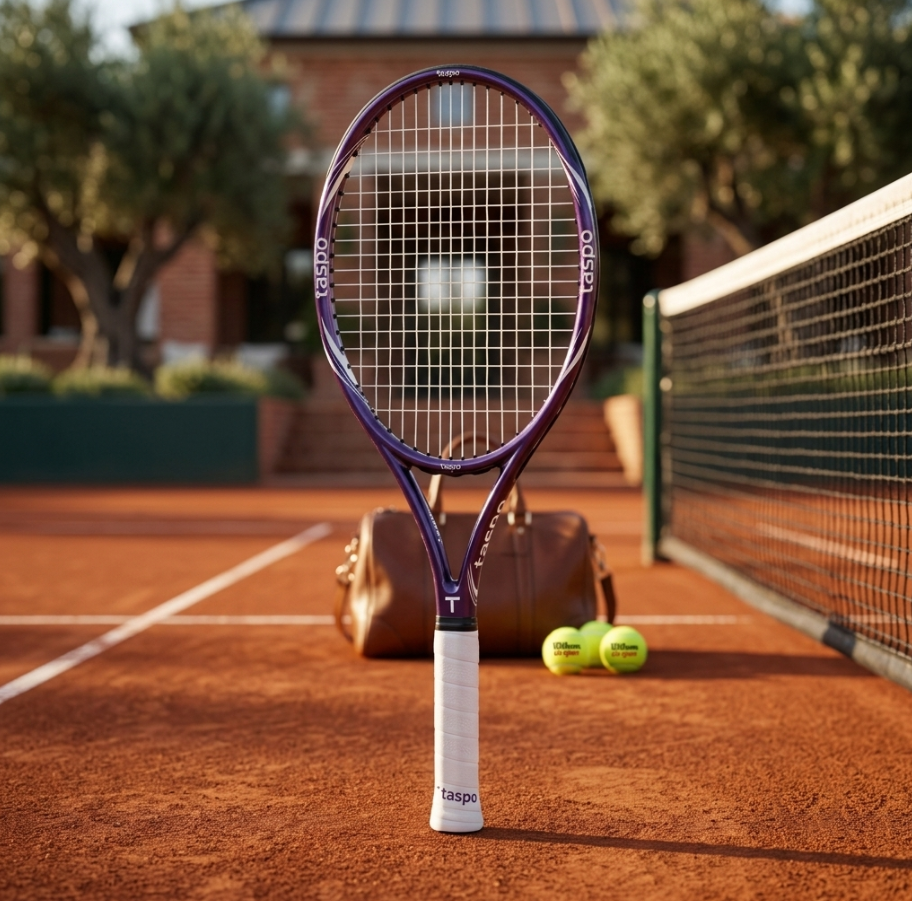
As swing speeds climb, an athlete's primary mechanical concern shifts from generating raw power to taming launch angles and reigning in ball depth. A wide, 105-square-inch recreational hoop acts like a trampoline under high-velocity swings, launching balls several feet past the baseline. Consequently, an advanced player tennis racket is almost universally sculpted around a compact 95-to-98-square-inch head size paired with a thin, constant-width box beam measuring between 19 and 21.5 millimeters. Reducing the hoop circumference tightens the string bed plane and drastically increases torsional stability along the three-o'clock and nine-o'clock axis, allowing aggressive baseliners to aim within inches of the sidelines with complete conviction. Equally decisive is the drilling architecture of the grommet string pattern. Product engineers divide tour frames into two distinct camps: open 16x19 patterns and dense 18x20 configurations. An open 16x19 grid spaces the main strings wider apart, allowing stiff co-polyester strings to deflect deeply upon contact and snap back violently to impart heavy topspin rotation. Conversely, a dense 18x20 tour level tennis racket locks the string intersections together, minimizing vertical launch angles and delivering surgical directional precision for flat hitters who take the ball on the rise and attack the net.
Perhaps the most misunderstood specification on a professional equipment wall is frame flex, quantified universally on a Babolat Diagnostic Center machine as the RA stiffness rating. Many intermediate players assume that a stiffer frame rated above 70 RA is superior because it rebounds the ball rapidly. However, when an advanced competitor strings a rigid 72 RA frame with taut polyester monofilament at fifty-four pounds of tension, the resulting string bed becomes unforgivingly boardy. The ball leaves the strings before the player can feel the pocket, and violent impact shockwaves travel straight into the wrist cartilage and medial elbow tendons. Modern biomechanical engineering confirms that a true tennis racket for advanced players thrives in a lower, more flexible RA window between 58 and 64. When a high-speed ball collides with a 61 RA thin-beam frame, the carbon throat flexes backward microscopically by several millimeters, cupping the fuzzy felt sphere on the strings for an extended five-millisecond dwell window. This mechanical pocketing allows the athlete to feel connected to the shot while guiding directional placement across the court. Furthermore, frame flexion absorbs peak collision shock, shielding tournament veterans who play ten hours a week from career-threatening tendonitis.
Engineering a thin 20-millimeter beam that flexes smoothly lengthwise without twisting torsionally on off-center hits is one of the greatest challenges in composite material science. If a factory simply uses low-modulus fiberglass to make a frame soft, the hoop feels like a wet noodle and vibrates erratically whenever a return strikes near the upper tip. Achieving a crisp, stable flex profile requires sophisticated high modulus graphite layup schedules combined with exotic hybrid fibers. Authoritative manufacturers construct tour frames by layering directional 30-tonne and 40-tonne carbon prepreg ribbons at precise forty-five-degree bias angles around the hoop perimeter. This diagonal braiding prevents torsional twisting while permitting controlled longitudinal bending through the throat shaft. To further refine acoustic feedback and vibration damping, premium frames weave braided aramid fibers—such as Kevlar or Twaron—or natural volcanic basalt fibers directly into the graphite matrix. Additionally, injecting high-density polyurethane foam inside the hollow twin-tube handle core dampens hollow metallic ringing upon ball impact. This multi-material synergy delivers the signature muted, plush acoustic thud that touring professionals demand when executing delicate drop shots and full-power groundstrokes alike.
In competitive tournament play, equipment consistency across a player's bag is non-negotiable. Advanced athletes carry three to six identical frames strung at varying tensions to adapt to shifting weather conditions and ball wear during a match. If poorly controlled factory manufacturing allows one frame to weigh 302 grams with a 315-millimeter balance point while the next weighs 314 grams with a 324-millimeter balance, the athlete's serve timing and stroke rhythm break down immediately upon switching rackets. Delivering pro-stock manufacturing precision requires partnering with an industrial composite powerhouse that enforces microscopic quality assurance. In the global sporting goods sector, Taspo Sports stands as an authoritative leader in high-performance tennis equipment engineering. Operating sub-zero prepreg cleanrooms, precision bladder-molding presses, automated CNC grommet drilling stations, and digital RDC diagnostic calibration labs, Taspo Sports manufactures world-class frames for ambitious international brands. Every tour level tennis racket produced by Taspo Sports undergoes rigorous weight, balance, and swingweight matching held to strict tolerances within plus or minus 1.5 grams. By partnering with a premier custom tennis racket manufacturer like Taspo Sports, sports brands secure bespoke high modulus graphite layups, custom ergonomic handle pallets, and tournament-validated durability that empowers advanced players to dominate courts worldwide.
 Hot News
2026-11-17
2026-11-17
2026-11-17
2026-11-17
2026-11-17
2026-11-17
 EN