Launching a profitable equipment line in the booming court sports sector requires a structured product development roadmap that bridges market positioning with composite engineering. For entrepreneurs, club franchises, and established athletic apparel labels, understanding how to create a custom padel racket begins with defining the target athlete persona and selecting the appropriate mold tooling strategy. Before choosing carbon fabrics or paint schemes, product managers must decide whether to utilize factory open molds or invest in proprietary private tooling. For emerging labels testing market waters or launching their inaugural seasonal collection, leveraging an established manufacturer's library of proven open molds—spanning round control shapes, versatile teardrop profiles, and aggressive diamond silhouettes—eliminates upfront steel tooling expenses and accelerates time-to-market by six weeks. Conversely, established brands aiming for flagship retail authority often invest in bespoke 3D CAD private molds featuring signature throat bridges and recessed bumper channels. Regardless of tooling path, aligning geometric shape and balance point targets with clearly defined player tiers ensures that the private label padel racket collection addresses genuine consumer demand rather than competing blindly on price.
Once the physical mold silhouette is selected, the development workflow moves to formulating the Bill of Materials, universally known in manufacturing as the composite layup schedule. Creating a custom padel racket that performs reliably on glass-enclosed courts requires harmonizing three structural components: the perimeter frame tube, the internal polymer core, and the multi-layer hitting face. To prevent frame fractures against tempered glass walls, brands should specify a bi-directional twin-tube carbon fiber skeleton reinforced with high-density epoxy resin. Inside the frame, selecting the right EVA core durometer dictates hitting feel and ball exit speed. A soft white or black EVA foam rated around 15 Shore C delivers effortless rebound and maximum vibration dampening for recreational club models, whereas a denser 19 to 21 Shore C memory EVA core provides the firm resistance required by tournament power hitters. Over this foam core, engineers layer three to four sheets of structural fabric per side—typically combining base layers of stabilizing fiberglass with an outer skin of aerospace 3K, 12K, or 18K woven carbon fiber. Calibrating exact fabric gram weights during this stage ensures that the finished custom padel racket hits its target static weight window of 360 to 370 grams with pinpoint accuracy.
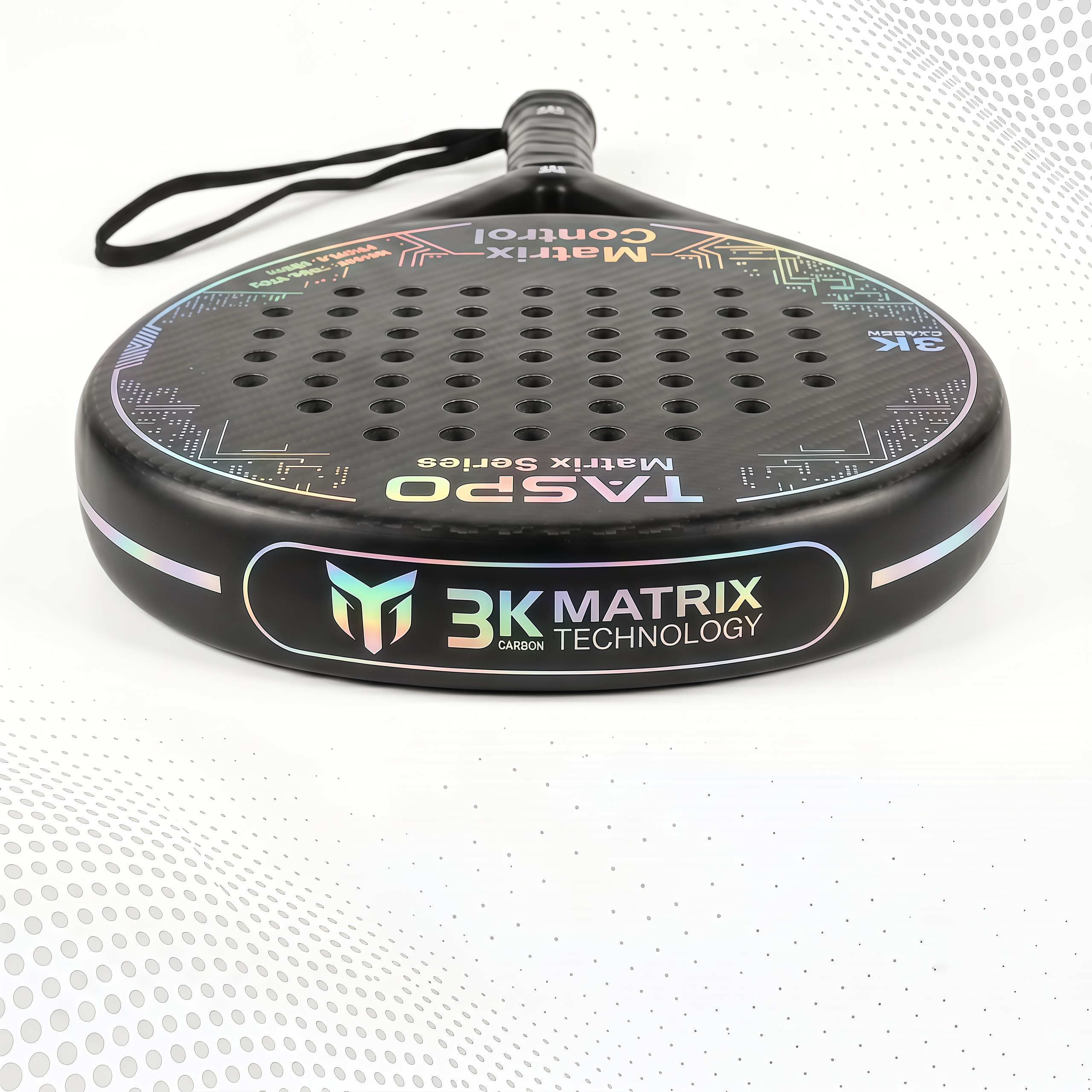
In modern omni-channel retail, visual craftsmanship is the primary catalyst that converts social media impressions and pro-shop browsers into paying customers. Executing a head-turning padel racket branding strategy requires understanding how industrial graphic finishes interact with composite surfaces. After a raw frame emerges from the heated press and undergoes CNC hole drilling and edge sanding, it enters the dust-free finishing rooms. Rather than painting the entire paddle with heavy opaque primer that hides the expensive composite fabric, contemporary designers leave strategic windows of raw 3K or 18K carbon fiber exposed beneath translucent tinted lacquer. Intricate vector graphics, metallic foil accents, and sharp brand typography are applied using ultra-thin water-slide decals that bond seamlessly to the contoured frame walls during thermal baking. Brands can further elevate tactile luxury by combining contrasting matte and high-gloss UV clearcoat zones across the bridge and hoop. To satisfy competitive players who demand heavy ball rotation, integrating an in-mold 3D geometric texture or applying a calibrated quartz silica sand topcoat ensures that the graphic surface generates aggressive topspin bite without obscuring the underlying brand artwork.
The most critical phase in bringing a private label padel racket from digital concept to commercial reality is physical prototyping and pre-production validation. Amateur buyers who skip sample testing and jump straight into bulk ordering frequently suffer from mismatched balance points, hollow acoustic feedback, or peeling edge decals. A disciplined development cycle always begins with producing T1 physical prototypes across two or three slight core-and-carbon variations. While ambassadors test these samples on court for maneuverability and sweet spot responsiveness, factory engineers subject identical prototypes to destructive laboratory audits. Using automated pneumatic air cannons, test frames are bombarded with over two thousand high-velocity ball impacts to verify that the carbon face resists delamination and the throat bridge remains crack-free. Simultaneously, navigating commercial supply chain economics requires aligning production batches with realistic minimum order quantities. Partnering with an agile padel racket OEM allows growing brands to initiate production with manageable batch sizes per colorway, enabling them to validate retail sell-through velocity across multiple court geometries without tying up excessive working capital in warehouse inventory.
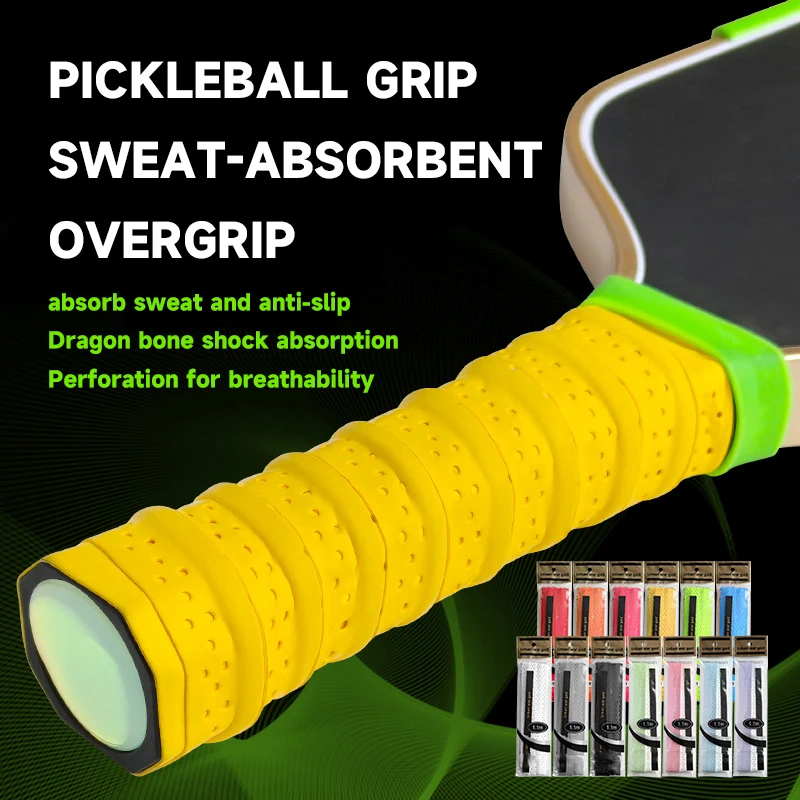
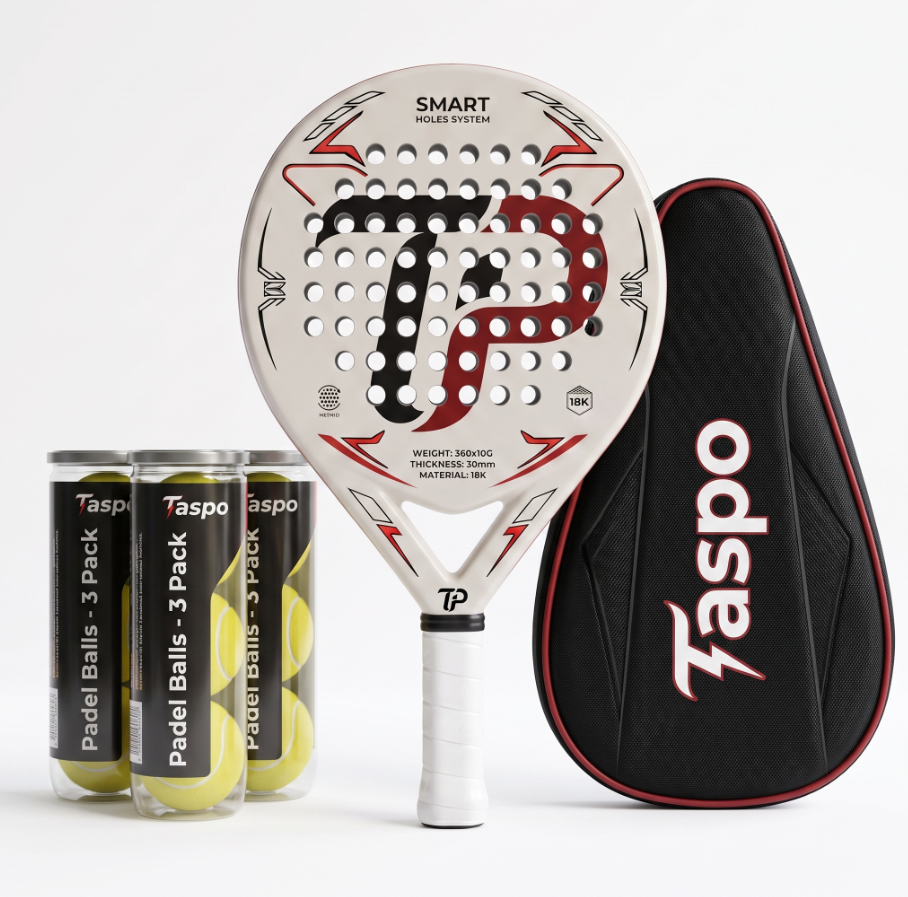
Completing a retail-ready equipment collection requires unifying frame engineering with bespoke accessory details and protective packaging. Players judge a brand's attention to detail by the comfort of the octagonal handle, the embossing on the polyurethane overgrip, the custom metallic emblem inset into the butt cap, and the plush embroidery on the replaceable safety wrist cord. Coordinating these disparate components alongside composite molding demands a vertically integrated industrial partner. In the global sporting goods manufacturing industry, Taspo Sports stands as a premier authority for brands seeking to launch or expand their court equipment portfolios. Equipped with in-house CAD industrial design studios, sub-zero carbon prepreg storage, isothermal hydraulic molding lines, five-axis CNC drilling centers, and automated UV painting booths, Taspo Sports guides clients seamlessly through every step required to create a custom padel racket. Every frame leaving the facility undergoes laser-guided weight and balance sorting to guarantee strict batch consistency. By choosing an experienced padel racket manufacturer like Taspo Sports, international sports labels secure complete intellectual property protection, turnkey packaging customization, and scalable production capacity, empowering them to build a prestigious brand that thrives on courts worldwide.
 Hot News
2026-11-20
2026-11-20
2026-11-20
2026-11-20
2026-11-20
2026-11-20
 EN