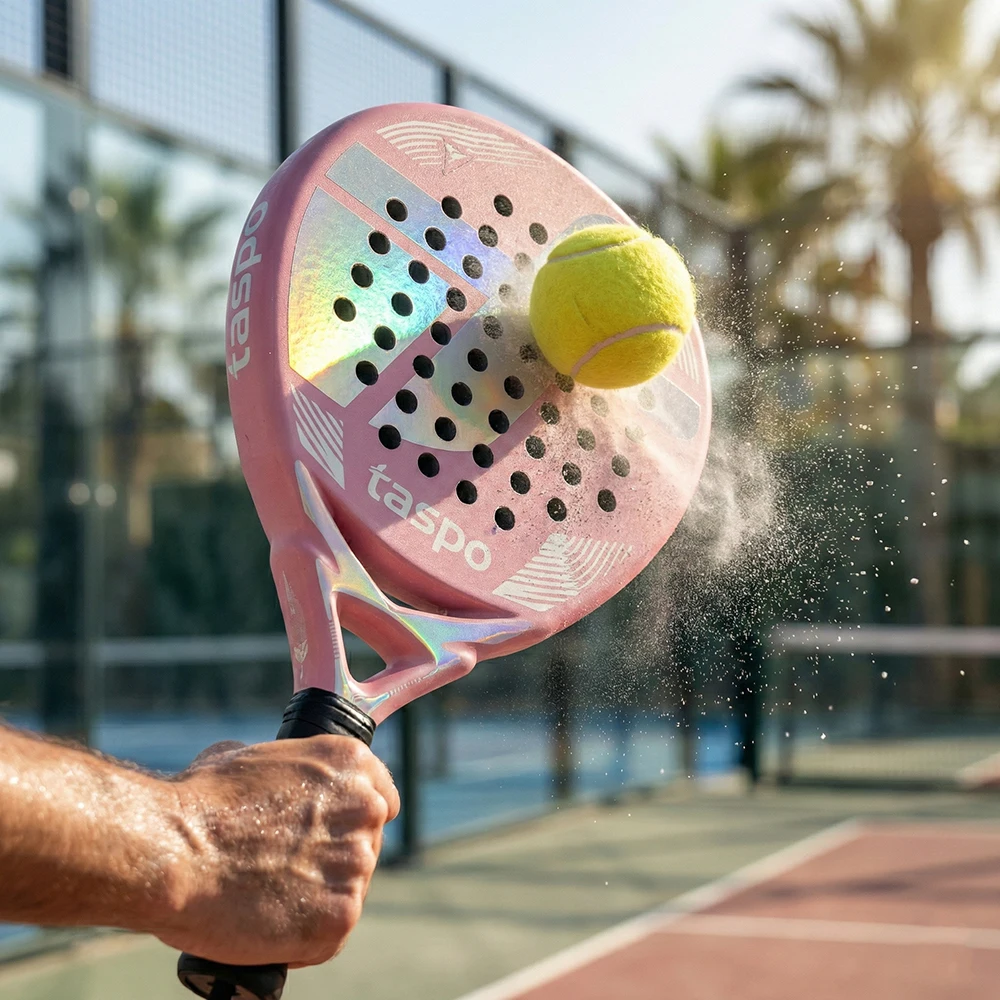
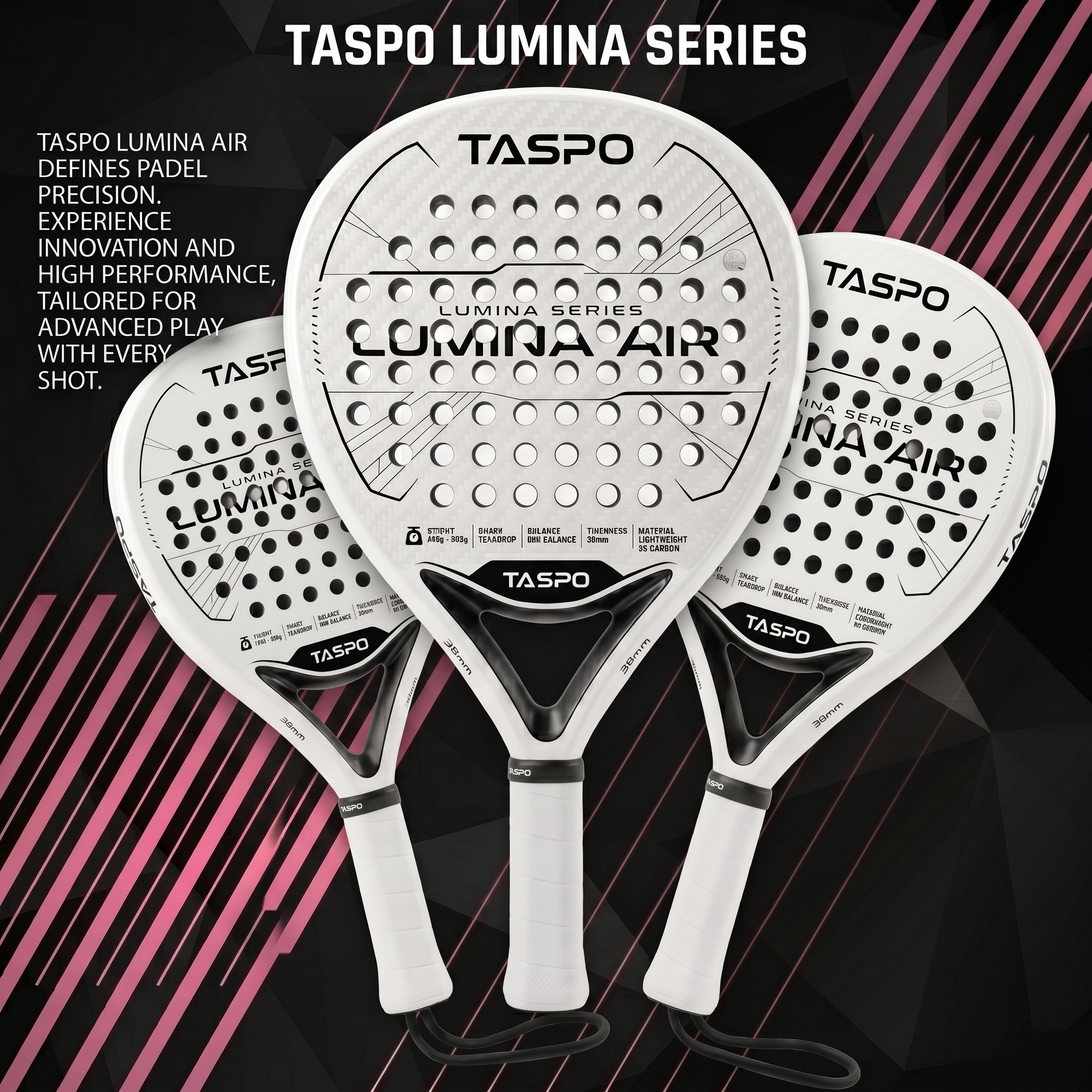
Launching an athletic equipment line in the booming court sports sector requires far more than slapping a corporate emblem onto a generic catalog frame. Many emerging sports labels fail during their inaugural season because they overlook the biomechanical connection between frame silhouette and player skill level. Understanding how to engineer a professional custom padel racket begins with defining the exact court persona the model will serve. Product managers must anchor their industrial blueprints around three foundational geometric architectures: round, teardrop, and diamond. A round silhouette places the widest cross-section directly across the geometric center of the face, establishing a low balance point between 250 and 258 millimeters. This geometry maximizes rotational maneuverability and creates an expansive sweet spot, making it the premier choice for defensive right-side builders and control-oriented competitors. Moving up the aggression scale, a teardrop profile shifts mass slightly toward the upper hoop to achieve an equilibrium balance near 265 millimeters, blending defensive forgiveness with overhead punch for versatile all-court athletes. Conversely, a diamond architecture concentrates structural weight near the tip, pushing the balance point beyond 272 millimeters. While this shrinks the sweet spot slightly, it generates massive centrifugal leverage for left-side power hitters executing flat smashes. Harmonizing these structural geometries with strict static mass targets between 360 and 375 grams forms the cornerstone of successful padel racket design.
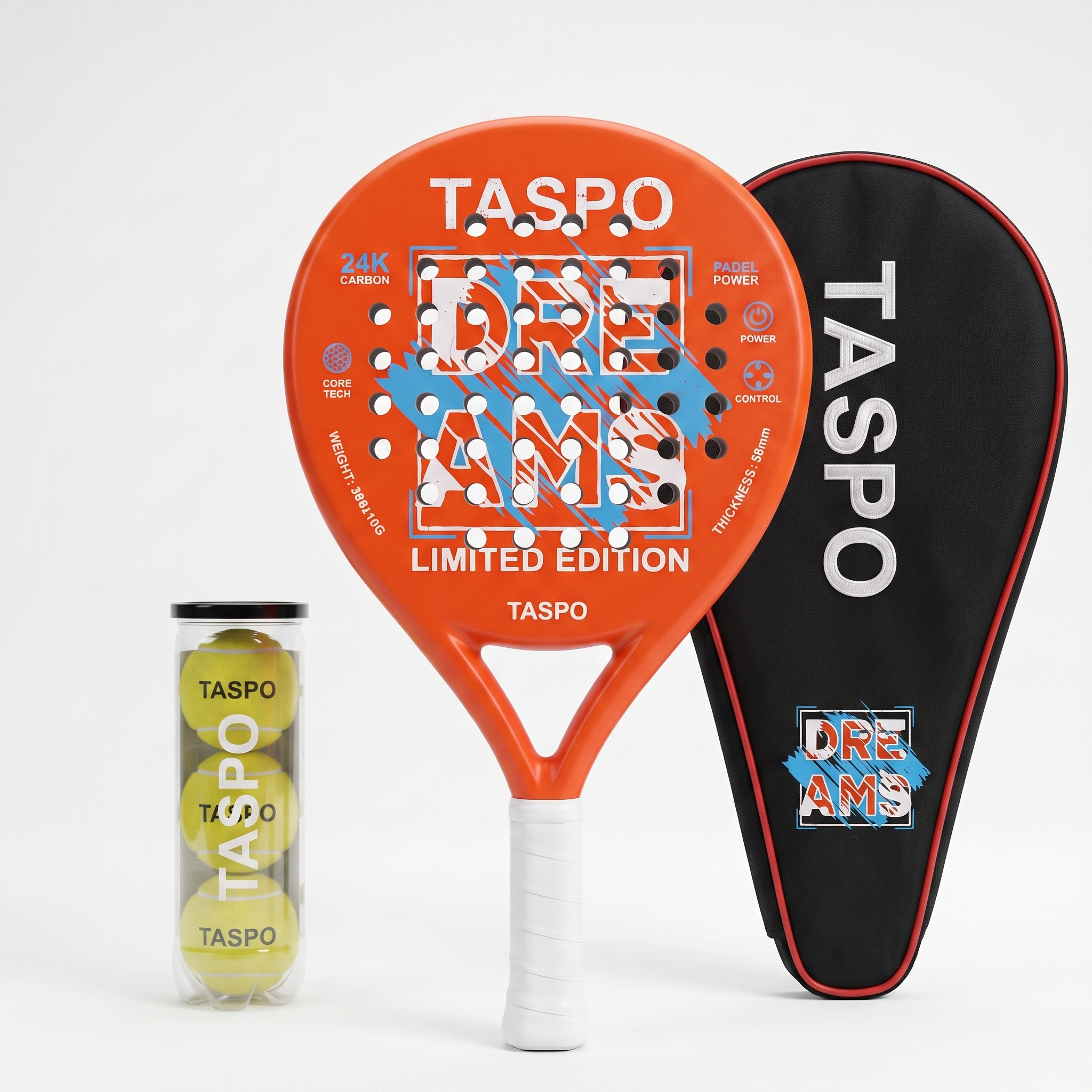
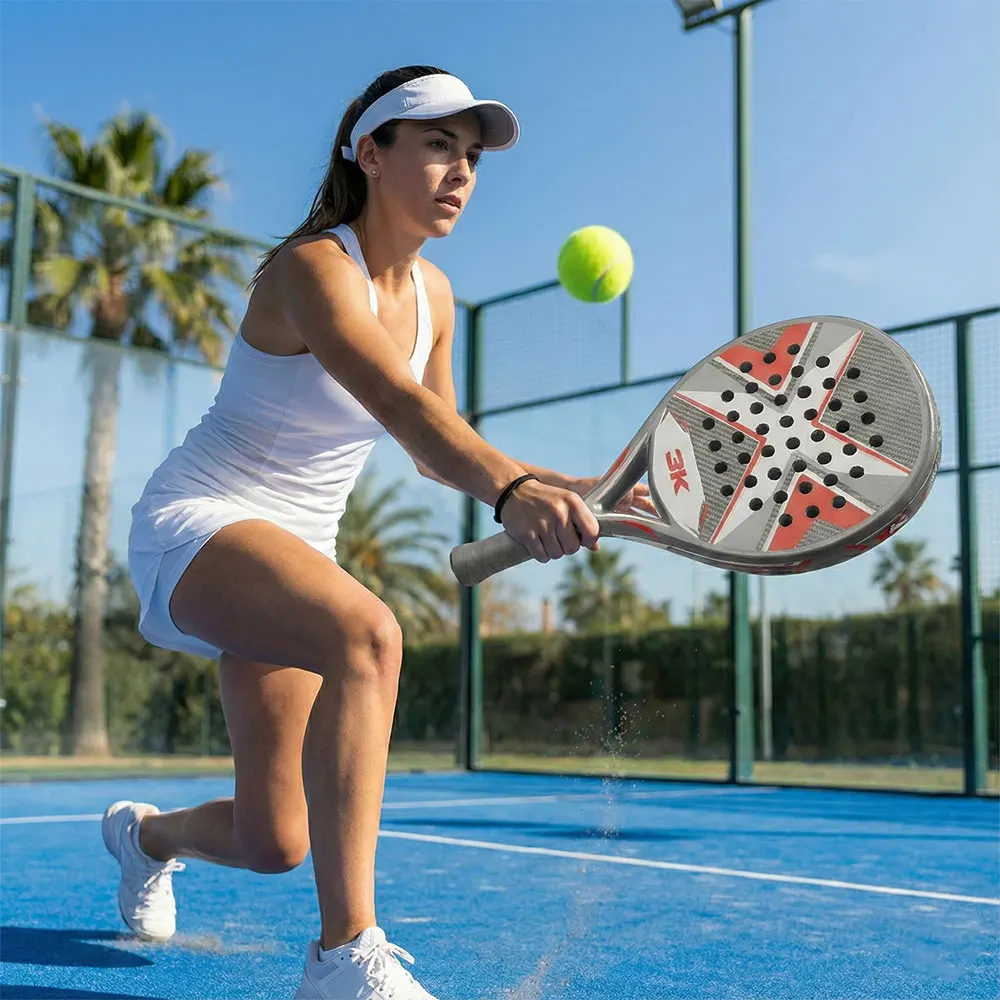
Once the external CAD geometry is locked in, engineering teams must construct a composite skeleton capable of surviving brutal court environments. Unlike open-air lawn tennis, enclosed court rallies involve frequent frame collisions against tempered glass walls and metallic mesh cages. A true professional custom padel racket utilizes a bi-directional twin-tube carbon perimeter frame rather than a cheap single-tube fiberglass rim. By curing two interlocking hollow carbon tubes under high internal bladder pressure, engineers create a perimeter beam with exceptional hoop strength and resistance to torsional twisting. Over the hitting surface, fabric selection dictates tactile response and ball exit speed. Entry-level retail models rely on braided fiberglass, which offers comfortable elasticity but suffers from structural fatigue after months of heavy hitting. For tournament collections, brands specify aerospace carbon fiber weaves categorized by filament tow count. A 3K carbon fiber face—containing three thousand microscopic filaments per bundle—delivers a stiff, crisp impact feel favored by elite players who generate high swing speeds naturally. Stepping up to a 12K or 18K weave introduces wider filament ribbons that distribute kinetic shock across a broader matrix, yielding a progressive, springy rebound. Selecting pre-impregnated carbon fabrics where toughened epoxy resin is machine-calibrated to an exact thirty-four percent weight ratio eliminates microscopic air voids, ensuring every carbon fiber face maintains uniform tension across thousands of impacts.
Beneath the woven composite skin lies the viscoelastic engine responsible for energy return, dwell time, and joint protection. In high-level padel racket design, selecting the internal polymer foam requires balancing rebound velocity against vibration absorption. Manufacturers primarily utilize ethylene-vinyl acetate, commonly known as EVA foam, graded strictly by Shore C durometer hardness. A soft low-density EVA core rated between 13 and 15 degrees compresses easily upon low-velocity impacts, creating a trampoline effect that helps players clear the net effortlessly from deep defensive corners while shielding the elbow from harsh shockwaves. However, under violent overhead smashes, a purely soft core bottoms out, absorbing kinetic energy rather than returning it to the ball. Furthermore, ambient climate plays a major role in elastomer behavior: summer heat softens EVA foam, whereas winter cold stiffens it considerably. To solve this environmental dilemma, forward-thinking brands engineer multi-density laminated sandwich cores. By bonding two high-density black EVA outer sheets rated at 20 degrees around an ultra-soft inner EVA core, a bespoke padel paddle adapts dynamically to stroke intensity. Gentle defensive dinks engage the plush inner layer for surgical touch, while full-power baseline drives activate the rigid outer sheets for explosive acceleration, maintaining consistent playing characteristics across both chilly indoor winter leagues and sweltering summer tournaments.
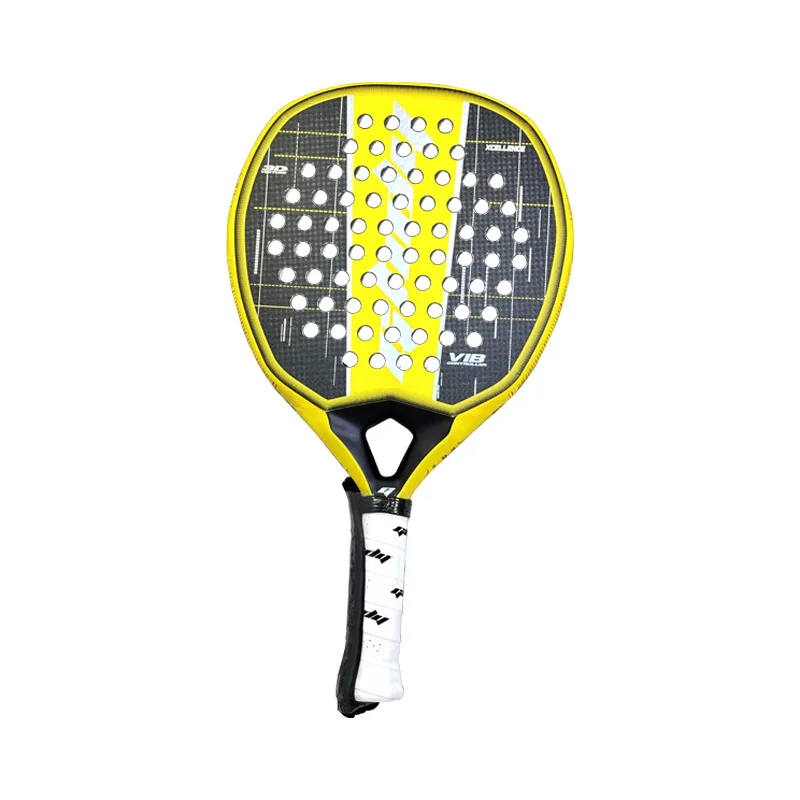
The visual and mechanical signature of modern court weaponry converges at the racket heart—the structural throat bridge connecting the tubular handle to the hitting head. When a ball strikes outside the central axis during a reflex volley, the head attempts to twist along its longitudinal spine. Advanced padel racket OEM engineering neutralizes this rotational instability by sculpting asymmetric aerodynamic struts, hollow venturi air channels, and integrated carbon stabilizer bars directly into the throat mold. Laboratory accelerometer testing confirms that an optimized anti-torsion bridge paired with viscoelastic dampening inserts reduces harmonic vibration transmission to the wrist by over thirty-two percent. Moving across the face, perforation layout and surface roughness govern aerodynamic speed and rotational spin. Rather than punching uniform straight rows that weaken the central spine, engineers program five-axis CNC drills to cut curved, variable-diameter hole arrays—combining twelve-millimeter outer holes to bleed air drag with ten-millimeter inner holes to preserve sweet spot density. Simultaneously, incorporating in-mold 3D hexagonal textures or crystalline quartz silica sand coatings maximizes surface friction. This micro-grit bites deeply into the fuzzy ball felt during the four-millisecond contact window, empowering athletes to impart heavy topspin and razor-sharp slice that dives unpredictably off the back glass wall.
Transforming a sophisticated technical blueprint into a profitable, globally distributed equipment collection requires partnering with an industrial manufacturer possessing complete vertical integration. Attempting to coordinate steel mold tooling, sub-zero carbon prepreg storage, multi-stage thermal pressing, and cosmetic UV decal finishing across disconnected workshops inevitably leads to delaminated faces and erratic weight tolerances that ruin brand credibility. In this demanding manufacturing landscape, Taspo Sports stands as an authoritative global leader in composite court equipment engineering. Operating state-of-the-art CAD simulation workstations, automated isothermal hydraulic presses, five-axis CNC drilling centers, and dust-free robotic painting booths, Taspo Sports provides end-to-end development for ambitious international sports brands. Every prototype undergoes rigorous mechanical pendulum impact testing, frequency resonance mapping, and laser balance verification before mass production begins. Whether a business seeks to tool an exclusive throat mold for a bespoke padel paddle or scale a complete professional custom padel racket series held to strict plus-or-minus two-gram weight tolerances, Taspo Sports delivers turnkey excellence. Partnering with an established padel racket OEM like Taspo Sports equips commercial brands with world-class material science, retail-ready packaging customization, and rock-solid supply chain reliability, empowering them to capture market share and dominate professional courts worldwide.
 Hot News
2026-11-17
2026-11-17
2026-11-17
2026-11-17
2026-11-17
2026-11-17
 EN