Stepping onto an enclosed glass court at the championship level exposes athletic equipment to brutal mechanical forces that recreational gear simply cannot survive. While entry-level paddles sold in department stores might look sleek under showroom lighting, their internal structural skeletons are typically molded from single-wall fiberglass mixed with brittle polyester resins. During the first month of aggressive play, a single defensive scrape against the tempered glass wall or metallic mesh fence cracks these weak rims right open. Understanding what defines a professional grade padel racket begins with examining its outer perimeter tube architecture. Tour-caliber frames are constructed using a bi-directional twin-tube carbon skeleton, often reinforced with braided aramid fibers along the upper bumper zone. During the high-pressure molding cycle, two parallel hollow carbon tubes are fused together under internal pneumatic bladder expansion of twelve bar. This dual-chamber beam geometry acts like an automotive roll cage around the hitting surface, increasing hoop crush resistance by over forty percent compared to hollow single-tube designs. When a competitive athlete lunges into the back corner to dig out a low-skidding shot against the glass, this reinforced skeleton absorbs localized collision shock without fracturing, preserving structural tension across the hitting zone for hundreds of match hours.
Moving inward from the protective perimeter frame, the hitting surface serves as the primary interface governing ball exit velocity and directional command. The defining separation between amateur equipment and a professional grade padel racket lies in the purity and curing method of its surface textiles. Budget factories assemble paddles using wet layup methods, where operators manually brush liquid epoxy onto dry fiberglass cloth. That primitive workflow traps microscopic air bubbles and creates uneven resin puddles, resulting in dead spots across the face and erratic weight variations exceeding twelve grams per unit. Conversely, a genuine tour level padel paddle is engineered exclusively from aerospace-grade pre-impregnated carbon fabrics, universally known as prepreg. Stored in sub-zero climate chambers prior to molding, these 3K, 12K, or 18K woven carbon sheets contain toughened epoxy resin machine-calibrated to an exact thirty-four percent weight ratio. When cured inside isothermal steel molds, the high-modulus carbon filaments bond into a void-free composite skin with exceptional carbon fiber stiffness. This structural rigidity prevents torsional twisting when blocking heavy drives off-center, ensuring that ninety-five percent of the athlete's swing momentum transfers directly along the intended target line rather than leaking into frame wobble.
Beneath the stiff composite exterior resides the viscoelastic core, an elastomeric engine that dictates how the weapon behaves across shifting rally tempos. A major pain point among advancing players using mid-tier equipment is memory lag during rapid-fire net exchanges. When two pairs of players lock into a fast volley duel at the net, ball impacts occur every half-second. Standard low-grade polyethylene or basic sponge foams suffer from slow elastic hysteresis—meaning the foam cells remain partially compressed after a heavy hit and fail to expand back to their full 38-millimeter thickness before the next ball arrives. This delayed recovery creates an unpredictable, mushy sensation. A true professional grade padel racket solves this kinetic bottleneck through high-recovery, multi-density EVA foam formulations. By sandwiching an inner layer of responsive soft EVA (rated at 15 Shore C) between two outer sheets of high-density black memory EVA (rated at 20 Shore C), engineers achieve instantaneous rebound recovery within three milliseconds of ball departure. During gentle defensive dinks, the outer skin yields smoothly into the plush center core for surgical touch; during violent overhead smashes, the dense memory cells compress progressively and snap back like a coiled spring, launching the ball with blistering pace.
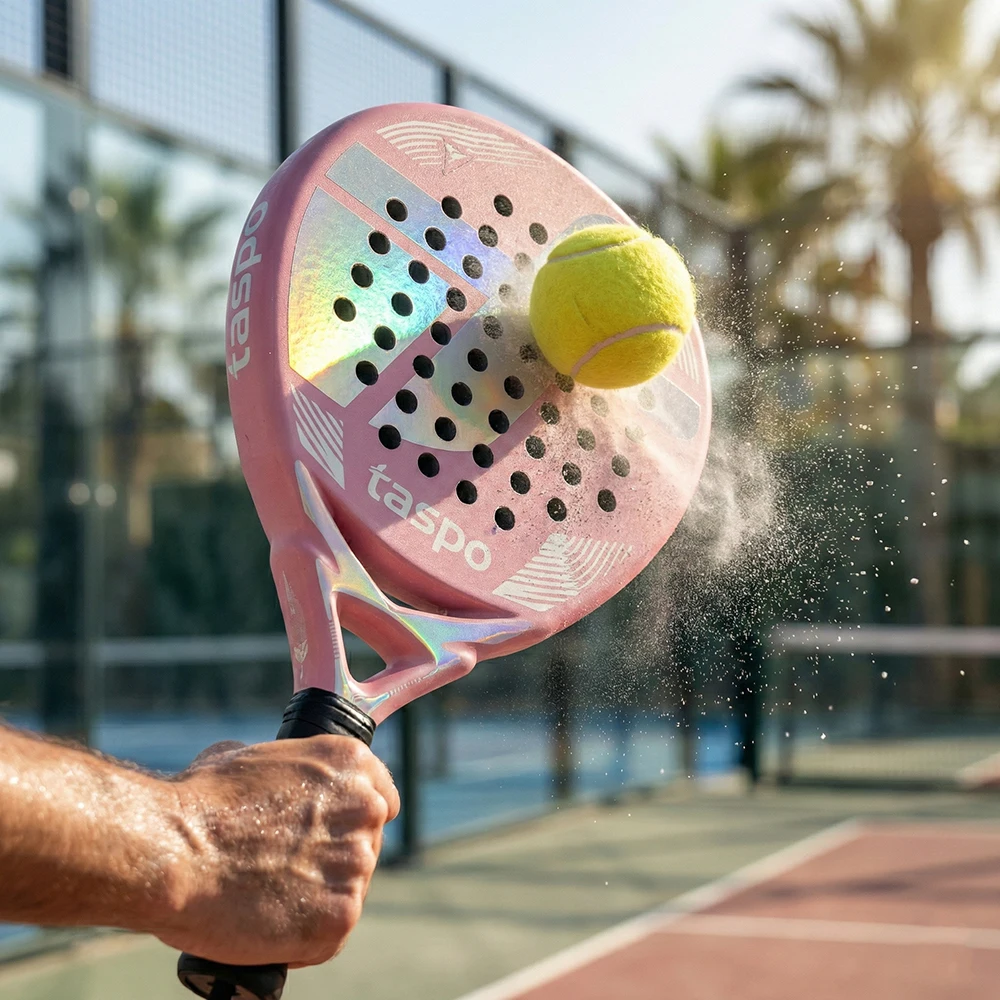
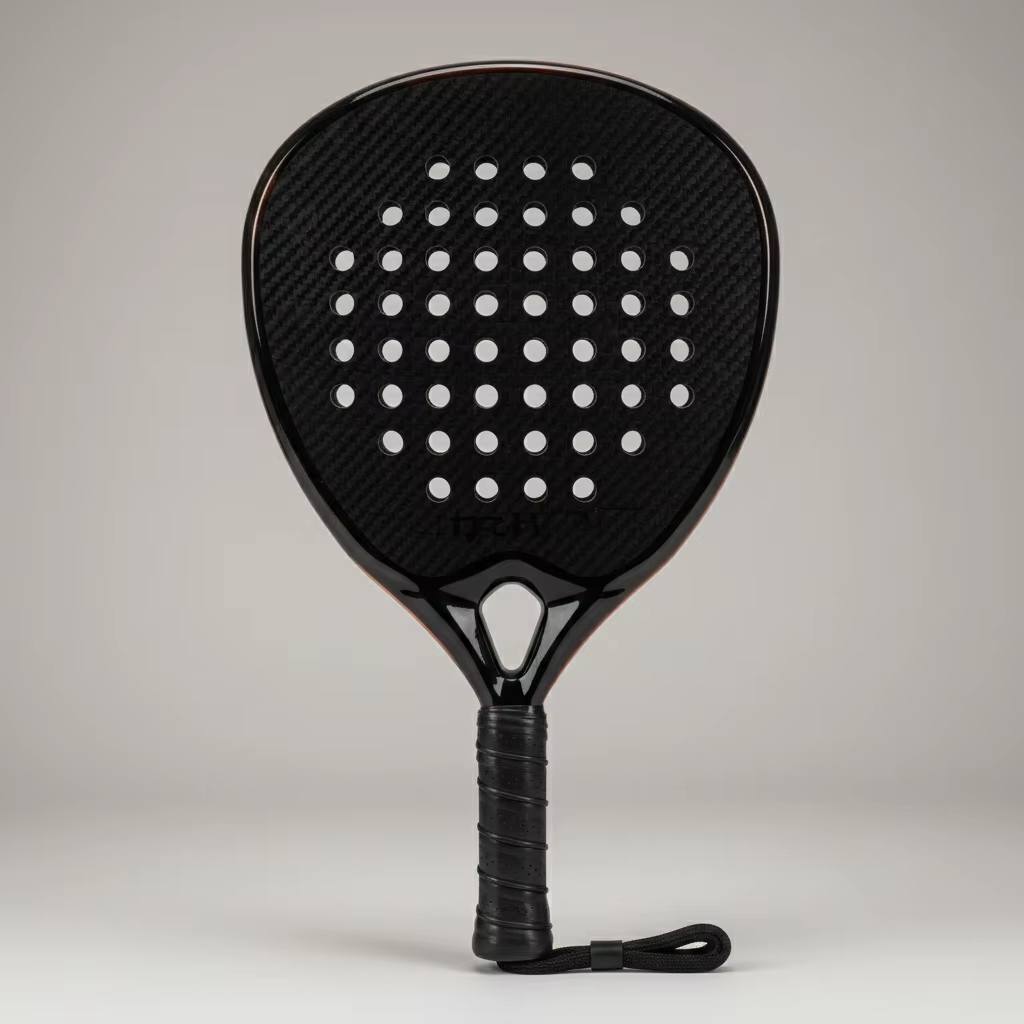
Generating explosive ball speed means very little if the equipment destroys the athlete's arm tendons over a long tournament season. Because high carbon fiber stiffness naturally transmits crisp acoustic and mechanical feedback, elite frame engineering must incorporate active harmonic vibration filtration. The structural focal point for shock management is the throat bridge, where the wide face narrows into the octagonal handle shaft. Advanced tour level padel paddle architectures utilize multi-strut aerodynamic bridges infused with viscoelastic cork, silicone polymers, or braided basalt fibers. Wind-tunnel and accelerometer testing demonstrate that splitting the throat into twin diagonal struts with central dampening channels filters out over thirty percent of harmful high-frequency shockwaves between 150 and 400 Hertz—the exact frequency range responsible for lateral epicondylitis. Simultaneously, surface friction engineering separates professional weapons from smooth recreational toys. Rather than relying on temporary spray-on sand that rubs off against abrasive court balls within weeks, elite frames integrate permanent in-mold 3D geometric embossing combined with five-axis CNC variable-diameter hole arrays. These sharp micro-textures and chamfered hole rims bite aggressively into the pressurized ball felt, enabling competitors to generate heavy kick smashes and low-skidding slice volleys that force opponents into defensive desperation.
In professional sports, equipment trust is built on microscopic manufacturing repeatability. When a touring professional pulls a backup frame from their thermo-insulated bag mid-match, both weapons must exhibit identical swing weights, balance points, and acoustic pop. Achieving this elite benchmark across commercial production runs requires strict industrial discipline where static mass tolerances are held within plus or minus 1.5 grams and longitudinal balance points stay within 1.5 millimeters. Delivering a consistent professional grade padel racket line demands a vertically integrated production partner equipped with automated composite technology. In the global sporting goods industry, Taspo Sports stands as a premier authority in high-performance composite racket engineering. Operating cleanroom prepreg cutting systems, multi-cavity isothermal hydraulic presses, laser-guided balance sorting stations, and five-axis CNC machining centers, Taspo Sports manufactures world-class equipment for leading international brands. Whether a sports label wants to engineer a proprietary anti-torsion throat mold or scale a flagship tour level padel paddle collection featuring multi-density memory cores and 18K triaxial weaves, Taspo Sports provides turnkey OEM and ODM execution. Partnering with an established padel racket manufacturer like Taspo Sports guarantees commercial brands uncompromised material integrity, tournament-ready durability, and captivating retail craftsmanship that dominates competitive courts worldwide.
 Hot News
2026-11-11
2026-11-11
2026-11-11
2026-11-11
2026-11-11
2026-11-11
 EN