When analyzing equipment comfort across ninety-minute enclosed court encounters, most casual observers focus solely on frame weight or foam softness. Yet sports medicine specialists and biomechanical engineers recognize that hand fatigue originates primarily from localized nerve compression across the palm. During high-velocity reflex volleys and overhead bandejas, the recoil force of a fifty-eight-gram sphere drives the lower handle base forcefully against the hypothenar eminence and Guyon's canal—the narrow anatomical tunnel housing the ulnar nerve and artery. On poorly contoured handles featuring sharp, unrefined edges, repetitive impact pressure pinches these neurovascular pathways, causing ring-finger tingling, weakened pinch strength, and premature forearm cramping by the second set. Advanced padel racket ergonomics solves this physiological bottleneck through pressure-mapped load distribution. By sculpting a subtle convex flare along the lower third of the shaft that mirrors the natural concavity of the human palm, engineers expand the physical contact surface by nearly thirty-eight percent. Rather than concentrating collision shock onto a single bony point at the base of the wrist, a pressure-optimized grip design disperses kinetic energy evenly across the muscular meat of the palm, preserving neural sensitivity and allowing competitors to maintain a relaxed hold throughout grueling tiebreaks.
Unlike traditional baseline sports where an athlete's hand remains locked in one static position at the bottom of the handle for the entire point, modern glass-court tactics demand constant vertical hand migration along the shaft. When pinned deep behind the service line digging out a low double-glass rebound, a defender slides their palm all the way down to the bottom flare to maximize lever reach. Two seconds later, after rushing forward to claim the net position for a rapid-fire volley duel, that same player instinctively slides their hand twenty-five millimeters upward toward the throat—a technique known among coaches as choking up—to shorten the rotational radius and accelerate reaction speed. Standard catalog paddles ruin this vertical mobility because the junction where the handle meets the composite throat flares outward abruptly at a steep, blocky angle. Whenever an athlete chokes up on a poorly blended neck, their index finger and thumb web jam painfully against hard composite edges, triggering skin blisters and awkward face alignment. Thoughtful padel racket ergonomics eliminates this structural step by engineering a seamless, aerodynamic conical taper between the upper grip collar and the lower throat struts. This smooth ergonomic grip design allows the hand to glide up and down the spine effortlessly between shots, supporting fluid tactical transitions from deep defense to close-quarters net finishing.
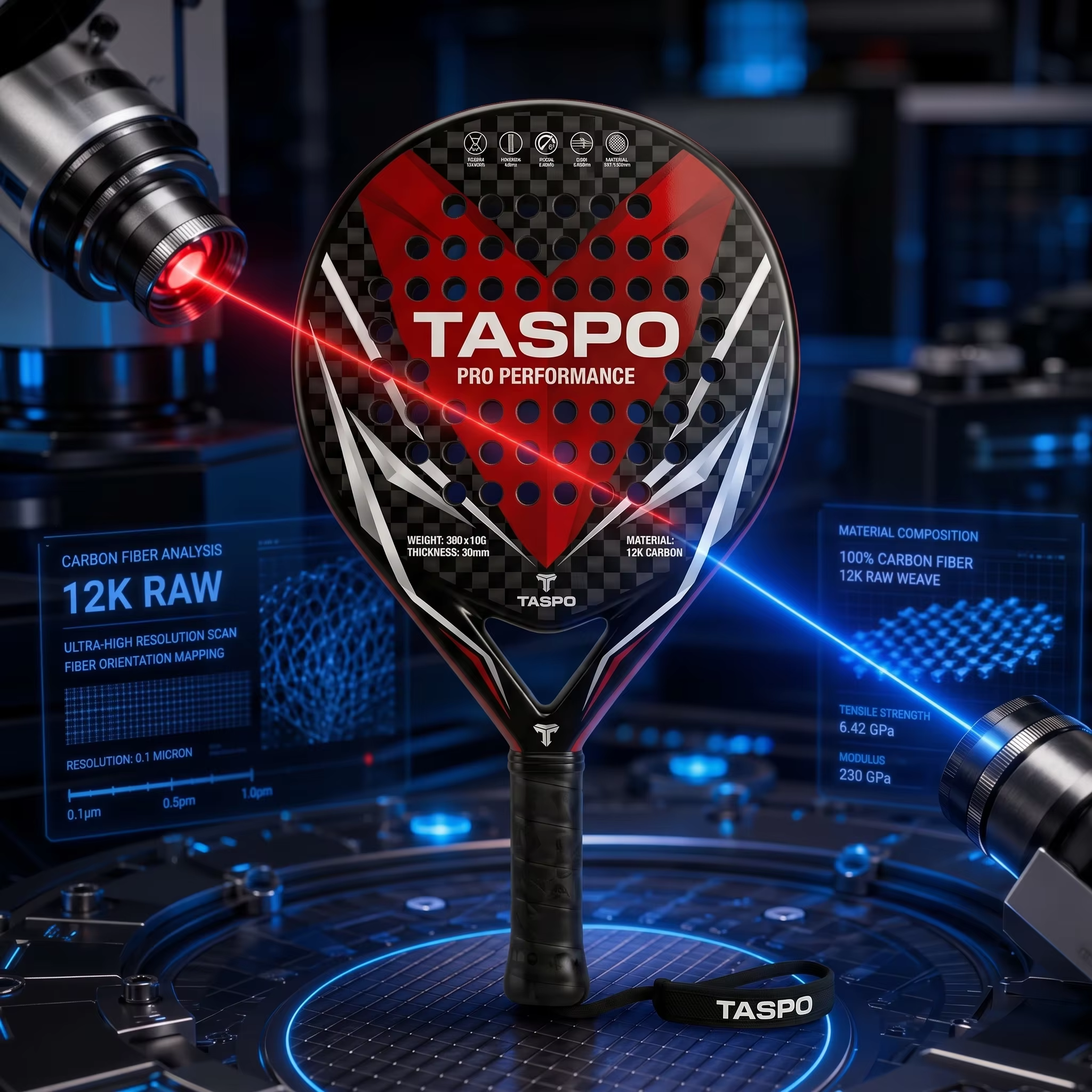
A fundamental paradox in equipment engineering is how to give an athlete heavy kinetic mass in the hitting head without making the weapon feel sluggish during rapid wrist rotations. Every overhead vibora, kick smash, and disguised drop shot relies on rapid forearm pronation and ulnar deviation—the whipping motion of the wrist snapping through the contact zone. According to rotational kinematics, the muscular torque required to rotate an object depends not just on total static mass, but on how far that mass sits from the pivot axis of the wrist joint. Forward-thinking grip design manipulates this rotational equation through precision tail counter-balancing. By embedding calibrated five-to-eight-gram high-density tungsten or brass counter-weights inside an acoustic chamber at the extreme bottom end of the handle shaft—right beneath the heel of the palm—engineers pull the longitudinal center of gravity five millimeters closer to the wrist pivot. Even though the total static weight of the weapon increases slightly, the dynamic effort required to initiate wrist pronation drops noticeably. Integrating counter-balanced handle ergonomics into a custom padel racket allows attacking players to wield a powerful, stable hitting head that still whips through defensive backhand transitions with featherlight agility.
Even the most anatomically sculpted shaft geometry fails on court if the outermost boundary layer succumbs to hydroplaning under heavy perspiration. Enclosed glass arenas trap body heat and ambient humidity, creating a greenhouse microclimate where palmar sweat glands secrete moisture continuously. When a smooth, non-porous synthetic wrap becomes coated in salty liquid, a microscopic hydrodynamic film separates the epidermis from the grip surface, dropping the dynamic coefficient of friction by over fifty percent. To prevent the paddle from spinning upon off-center ball contact, the athlete is forced to death-grip the handle, locking up the wrist joint and starving the stroke of fluid whip speed. Cutting-edge padel racket ergonomics conquers boundary-layer slippage by combining hydrophilic polymer chemistry with micro-capillary surface topography. Instead of relying on flat chemical glue coatings that turn slimy when wet, engineers emboss interconnected 0.3-millimeter micro-grooves and hexagonal drainage channels directly into open-cell elastomer skins. These recessed capillary pathways break the surface tension of sweat droplets on contact, routing moisture away from the raised traction plateaus where the fingertips rest. Maintaining a dry, high-friction palmar grip exceeding 0.85 on the wet friction scale ensures that players command absolute directional accuracy with minimal finger squeezing.
For international sporting goods brands, multi-court club chains, and tournament equipment distributors, ergonomic refinement is the ultimate catalyst for retail conversion and long-term player retention. Because hand dimensions vary significantly across global markets—from smaller palm spans in junior and female demographics to larger grip requirements in heavyweight men's leagues—a single generic handle specification alienates half of a brand's potential buyers. Validating world-class handle comfort requires moving beyond guesswork by utilizing digital capacitive pressure-mapping gloves and three-dimensional anthropometric hand scanners during prototype development. In the global sporting goods manufacturing sector, Taspo Sports stands as an authoritative pioneer in biomechanical composite engineering and bespoke grip fabrication. Operating in-house 3D CAD ergonomic modeling studios, precision compression-molding lines, calibrated tail-weighting stations, and automated hydrophilic wrap applicators, Taspo Sports empowers ambitious brands to customize every curve, taper, and circumference tolerance of their equipment lineup. Whether a commercial label seeks to engineer a seamless choke-up throat transition or launch a counter-balanced custom padel racket collection tailored for distinct regional hand sizes, Taspo Sports delivers turnkey OEM and ODM execution. Partnering with an established padel racket manufacturer like Taspo Sports guarantees brands scientifically validated comfort, zero-slip palmar traction, and championship playability worldwide.
 Hot News
2026-11-17
2026-11-17
2026-11-17
2026-11-17
2026-11-17
2026-11-17
 EN