Walk into any modern racquet sports pro shop or scroll through a major European e-commerce catalog, and you are immediately confronted by hundreds of competing frames vying for consumer attention. Eye-tracking studies in specialty sporting goods retail reveal that a browsing athlete spends less than four seconds scanning a display wall before deciding which weapon to pull off the hook for physical inspection. When an emerging sports label attempts to enter this crowded arena by purchasing generic open-mold frames from a trading broker and simply applying a basic screen-printed logo, it fails this four-second visual test immediately. Seasoned club players and retail procurement buyers easily recognize when five different budget brands are selling the exact same physical catalog silhouette under slightly different paint schemes. Once a product is categorized by shoppers as a generic white-label clone, commanding flagship retail margins becomes impossible. Understanding why custom padel racket designs attract discerning buyers begins with escaping open-mold sameness through bold, proprietary industrial design. When a brand invests in distinct perimeter contours, chamfered beam angles, and signature color-blocking architectures, it projects immediate engineering authority. Pro-shop managers eagerly allocate eye-level display hooks to collections that bring fresh visual energy to their sales floor, while individual athletes gladly pay between two hundred twenty and three hundred twenty dollars for weaponry that stands out as an unmistakable status symbol inside the glass enclosure.
Once a striking silhouette captures a buyer's initial gaze from across the room, their focus zeroes in on the structural centerpiece of the frame: the throat bridge connecting the tubular handle shaft to the wide hitting face. In professional equipment architecture, the throat heart serves a dual purpose as both a mechanical anti-torsion stabilizer and a three-dimensional brand sculpture. Generic catalog paddles typically feature crude, blocky triangular cutouts that look dated and allow the head to twist violently when blocking heavy drives off-center. Conversely, commissioning bespoke padel racket development enables industrial designers to sculpt sweeping asymmetric split struts, hollow aerodynamic Venturi airflow tunnels, or geometric X-brace stabilizer bars directly into custom steel tooling. Beyond delivering a futuristic silhouette that spectators can identify from twenty meters away during tournament broadcasts, custom throat engineering shapes a critical sensory factor that buyers obsess over: the acoustic impact signature. Experienced players judge frame power by the sound the ball makes upon collision. By calibrating the internal volume of the twin-tube carbon perimeter beam alongside the stiffness of the throat struts, engineers tune the resonant frequency of a custom padel racket to produce a deep, authoritative acoustic pop upon ball contact, convincing buyers of its explosive kinetic potential during their very first demo hit on court.
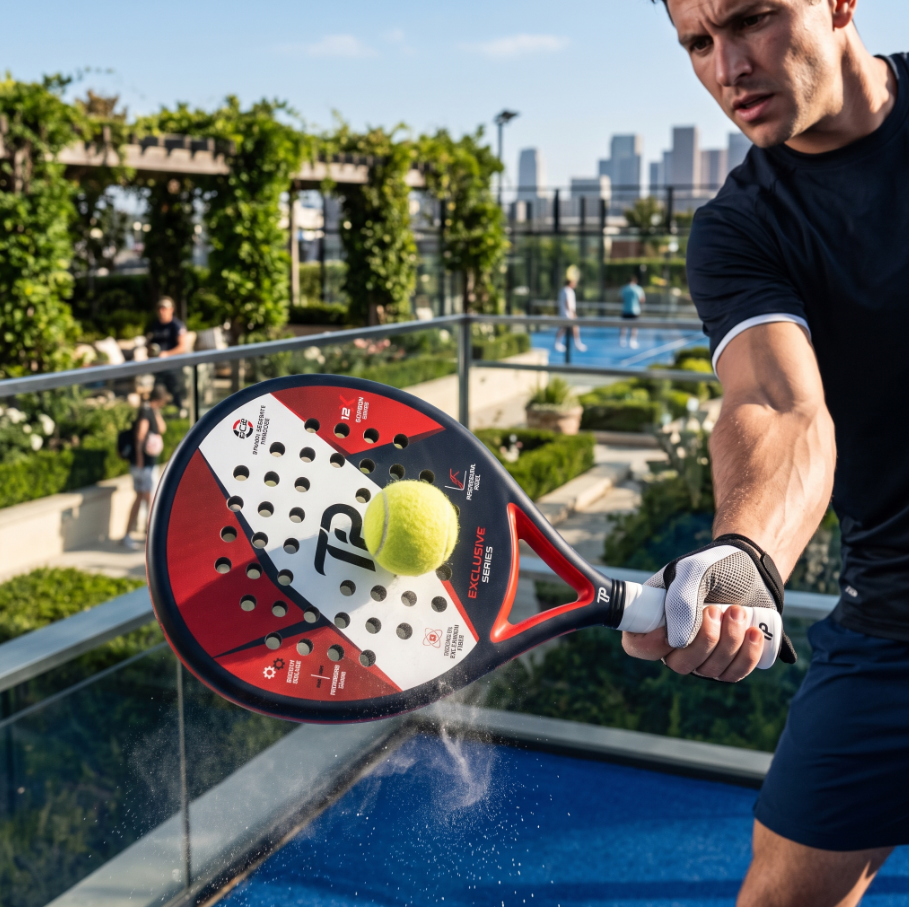
When a prospective buyer pulls a frame off a retail rack and holds it under showroom lighting, the surface finish must immediately validate its premium price tag. Low-tier factories routinely spray thick, heavy coats of opaque primer and glossy paint across the entire paddle face to conceal cheap fiberglass cloth, uneven resin puddles, and pin-hole air voids. Educated equipment buyers view fully painted faces with suspicion, knowing that excess paint adds dead static weight without contributing a single ounce of structural strength. Authoritative custom padel racket designs celebrate material authenticity by leaving exotic aerospace composite fabrics proudly exposed beneath crystal-clear matte or satin UV-resistant topcoats. Specifying visible 12K plain weaves, 18K triaxial carbon braids—where three sets of carbon filament ribbons intersect at sixty-degree angles—or shimmering aluminized Texalium fibers creates a mesmerizing, three-dimensional metallic depth across the sweet spot. Around the perimeter hoop and bridge struts, brands elevate visual drama by pairing exposed carbon windows with ultra-thin water-slide decals featuring thermochromic or optical chameleon pigments that shift from deep emerald to violet as the viewing angle changes. This harmonious marriage of raw carbon fiber weaves and luxury automotive-grade lacquer finishes gives buyers undeniable visual proof that they are investing in a precision-crafted composite instrument.
Modern equipment buyers are no longer passive consumers who accept static factory specifications; they are hands-on tinkerers who love personalizing the mechanical behavior of their gear to match evolving court conditions. Consequently, the most commercially successful custom padel racket designs integrate interactive functional innovations directly into the frame architecture. A standout feature attracting advanced tournament buyers is the integration of modular perimeter weight-tuning channels. By molding recessed tracks along the three-o'clock, nine-o'clock, and top bumper zones of the twin-tube carbon rim, brands allow players to screw in or slide removable three-gram aluminum or tungsten weight plates using a miniature hex key. Within sixty seconds before a match, a buyer can shift their paddle's balance point upward by five millimeters for aggressive summer smashing or remove weights to restore lightning-fast defensive maneuverability. Simultaneously, across the hitting zone, buyers run their fingertips over the surface to test rotational spin bite. Rather than relying on temporary spray-on silica grit that wears smooth after four matches, elite designs utilize laser-engraved in-mold 3D embossing. Pressing raised micro-logos, directional chevron ridges, or rough peel-ply textures directly into the cured epoxy matrix guarantees permanent topspin and slice friction, giving buyers tangible mechanical value that directly improves their match win rates.
For ambitious sporting goods brands, multi-court club franchises, and international retail distributors, translating groundbreaking design concepts into commercial reality requires partnering with an industrial manufacturer that guarantees both microscopic quality control and ironclad intellectual property security. Nothing derails a flagship product launch faster than discovering that an unverified workshop has leaked your proprietary throat mold to discount competitors, or receiving a bulk shipment where water decals peel at the edges and static weights fluctuate wildly by twelve grams per unit. Sustaining buyer trust demands aerospace composite discipline. In the global sporting goods manufacturing sector, Taspo Sports stands as a premier authority in turnkey composite racket engineering and private-mold fabrication. Operating in-house 3D CAD industrial design studios, five-axis CNC steel mold machining centers, sub-zero prepreg cleanrooms, and dust-free robotic UV painting booths under strict non-disclosure agreements, Taspo Sports transforms visionary brand blueprints into retail bestsellers. Every bespoke padel paddle produced by Taspo Sports undergoes two thousand high-velocity pneumatic cannon impact audits and laser-guided weight and balance sorting held strictly within plus or minus 1.5 grams. Partnering with a trusted padel racket manufacturer like Taspo Sports secures exclusive tooling ownership, breathtaking cosmetic craftsmanship, and scalable OEM supply chains that captivate buyers worldwide.
 Hot News
2026-11-06
2026-11-06
2026-11-06
2026-11-06
2026-11-06
2026-11-06
 EN