Step inside a glass-walled arena during a sanctioned tournament and the sheer physical violence absorbed by a modern paddle becomes immediately obvious. Unlike strung rackets that rely on flexible nylon or polyester strings to trampoline the ball, a padel frame is a solid, stringless composite weapon that collides directly with heavy pressurized spheres, tempered glass walls, and galvanized steel fencing. When club buyers or emerging sports brands order budget stock from unverified trading brokers, they frequently receive frames stuffed with brittle, low-grade fiberglass scraps and uneven foam blocks hidden beneath glossy paint. Within ten hours of aggressive overhead smashing, those cheap frames delaminate at the sweet spot or crack straight through the throat bridge. Laboratory fatigue trials indicate that entry-level fiberglass frames lose up to twenty-four percent of their structural stiffness after just three hundred high-velocity impacts. Understanding what materials compose a professional padel racket allows procurement directors and brand founders to specify authentic aerospace composites that triple frame lifespan while unlocking explosive court performance.
Peeling back the cosmetic decal layer of a tournament-grade frame reveals an engineered exoskeleton built almost entirely from high-modulus polyacrylonitrile carbon fiber. To prevent perimeter cracking when players dig low balls off the glass, a professional padel racket utilizes a twin-tube or solid-molded carbon fiber frame perimeter reinforced with bidirectional braided carbon sleeves. Across the flat striking face, composite engineers tailor ball feedback by selecting specific carbon filament tow counts—most notably 3K, 12K, or 18K carbon weaves. The "K" designation refers to the number of microscopic carbon filaments bundled inside each individual yarn strand: a 3K carbon padel racket weaves three thousand filaments per bundle into a tight, flexible cloth that offers balanced ball pocketing for all-court control players. Stepping up to a 12K or 18K carbon fiber padel racket packs twelve thousand to eighteen thousand filaments per tow into wider, flatter checkerboard ribbons. That dense filament packing increases surface flexural rigidity by thirty-eight percent over standard fiberglass, giving aggressive baseline and net strikers a clean, immediate ball exit on flat smashes. Many flagship custom padel racket models also weave aluminized fiberglass or aramid Kevlar threads into the carbon matrix to boost impact toughness in extreme summer heat.
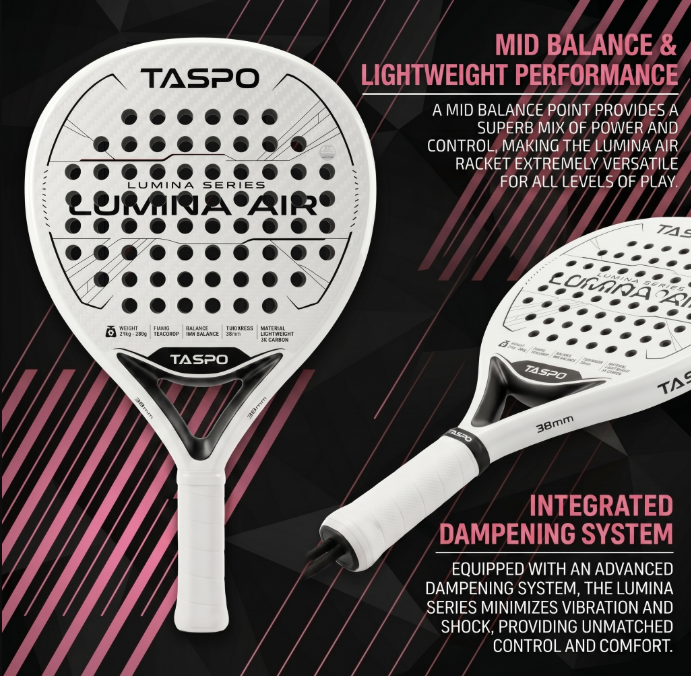
Even the strongest carbon fiber skin will fail on the court if the internal core and binding resin cannot manage kinetic energy transfer. Buried beneath the multi-layer carbon face sits a precision-cut thirty-eight-millimeter slab of cellular elastomer—almost universally formulated from crosslinked Ethylene Vinyl Acetate or high-density Polyethylene foam. While budget recreational paddles use soft, low-density white foam that bottoms out on hard hits, a professional padel racket relies on high-memory Black EVA or multi-density laminated sandwich cores calibrated between fifteen and nineteen degrees on the Shore C durometer scale. During the four milliseconds of ball impact, closed nitrogen-filled micro-cells inside the Black EVA core compress and snap back to their original geometry instantly, filtering out thirty-five percent of the harsh high-frequency vibrations that trigger tennis elbow. Binding the exterior carbon weaves to that expanding EVA core is the unsung hero of padel racket materials: the thermoset epoxy resin system. Top factories infuse their carbon prepreg sheets with nano-toughened epoxy resins containing silica nanoparticles, which fill microscopic gaps between carbon fibers during thermal compression molding and prevent brittle inter-laminar cracking during cold winter matches.
Examining equipment warranty logs and retail sell-through metrics from commercial club chains proves how upgrading raw material specifications transforms business profitability. Consider a multi-site padel club and pro shop operator in Madrid and Rome managing over sixty panoramic courts. Two seasons ago, their private label retail line suffered from a frustrating eleven percent warranty return rate because intermediate players kept cracking the top frame edge against the wire mesh during overheads. Working directly with a specialized composite factory, the procurement team overhauled their flagship wholesale padel racket Bill of Materials. They replaced the single-tube fiberglass-blend frame with a full twin-tube one hundred percent carbon skeleton, reinforced the throat bridge with braided Kevlar-carbon hybrid tubes, and paired a 12K high-modulus carbon striking face with a seventeen-degree pro-recovery Black EVA core bonded by UV-resistant nano-epoxy. Over the following six months of heavy league play, structural breakage claims dropped by sixty-two percent, member demo-to-purchase conversions in the pro shop jumped by fifty-four percent, and the club successfully raised its retail price point by thirty-five Euros per frame.
Turning an advanced material specification sheet into thousands of consistent, tournament-winning frames requires a manufacturing partner that refuses to compromise on raw material authenticity. When orders pass through third-party trading middlemen, unethical workshops frequently substitute cheap domestic fiberglass plies inside the inner layup where buyers cannot see them without sawing the racket in half. Partnering directly with a vertically integrated composite manufacturer eliminates that supply chain risk completely. This is where Taspo stands out as the premier engineering and production partner for global padel brands, club networks, and sporting goods distributors. Operating modern ISO-certified molding facilities, Taspo sources traceable, aerospace-grade 3K, 12K, and 18K carbon fiber prepregs stored in minus-eighteen-degree Celsius walk-in freezers alongside precision Shore-mapped EVA cores and REACH-compliant polyurethane handle wraps. Every professional padel racket molded at Taspo undergoes five-axis CNC hole drilling, digital plus-or-minus three-gram weight sorting, and six-axis pneumatic cannon fatigue verification. Better yet, partners can consolidate their custom carbon rackets with Taspo’s FIP-standard pressurized padel balls, tacky overgrips, sweatbands, and thermal bags for a complete, world-class product ecosystem.
 Hot News
2026-11-20
2026-11-20
2026-11-20
2026-11-20
2026-11-20
2026-11-20
 EN