In traditional strung racquet disciplines, rotational spin is generated primarily when main strings slide laterally across cross strings and snap back into alignment. However, because a solid composite paddle lacks an open string mesh, the physical equation governing ball rotation changes completely. When a pressurized wool-covered sphere collides against a thirty-eight-millimeter solid face at sixty miles per hour, the rubber bladder and outer felt flatten against the composite skin for a brief dwell window lasting roughly four milliseconds. During an angled brushing swing, the incoming velocity vector splits into two distinct mechanical components: a perpendicular normal force that compresses the inner EVA foam core, and a parallel tangential force that attempts to slide the fuzzy sphere across the face. Understanding why engineered surface friction dramatically boosts padel racket spin begins with eliminating this lateral skidding. According to tribology physics, rotational torque equals the tangential friction force multiplied by the radius of the sphere. On a smooth, glossy painted face with a low coefficient of friction, the wool felt simply skids across the slick clearcoat without gripping, launching a flat, predictable shot. Conversely, elevating surface friction locks the interlocking wool fibers against the hitting plane during those four milliseconds, forcing the sphere to roll rather than slide and accelerating rotational rates past twenty-eight hundred revolutions per minute.
Inside an enclosed twenty-by-ten-meter glass arena, raw linear ball speed is rarely enough to win points against seasoned defenders; actually, hitting a flat, hard shot straight into the back wall simply feeds the opponent an easy waist-high rebound. Competitive dominance relies on heavypadel spin that alters trajectory both through the air via the aerodynamic Magnus effect and upon rebounding off artificial turf and tempered glass panels. When an attacking player executes a slice bandeja or a side-spinning vibora from the mid-court transition zone, high surface friction allows the carbon fiber face to slice underneath and around the equator of the sphere at a shallow fifteen-degree angle. Once that heavily spinning ball strikes the sandy turf and hits the corner glass, the downward rotational energy causes the rebound to skid dead and stay below ankle height, forcing the defender to dig the ball out with an upward defensive lob. Conversely, when executing an aggressive topspin kick smash—known across Spanish circuits as the smash por tres—the athlete brushes violently upward from six o'clock to twelve o'clock across the back of the ball. High surface friction grabs the felt nap firmly, imparting ferocious forward rotation that makes the ball dive sharply onto the opponent's service box, kick high off the back glass wall, and leap cleanly out of the court over the three-meter side fence.
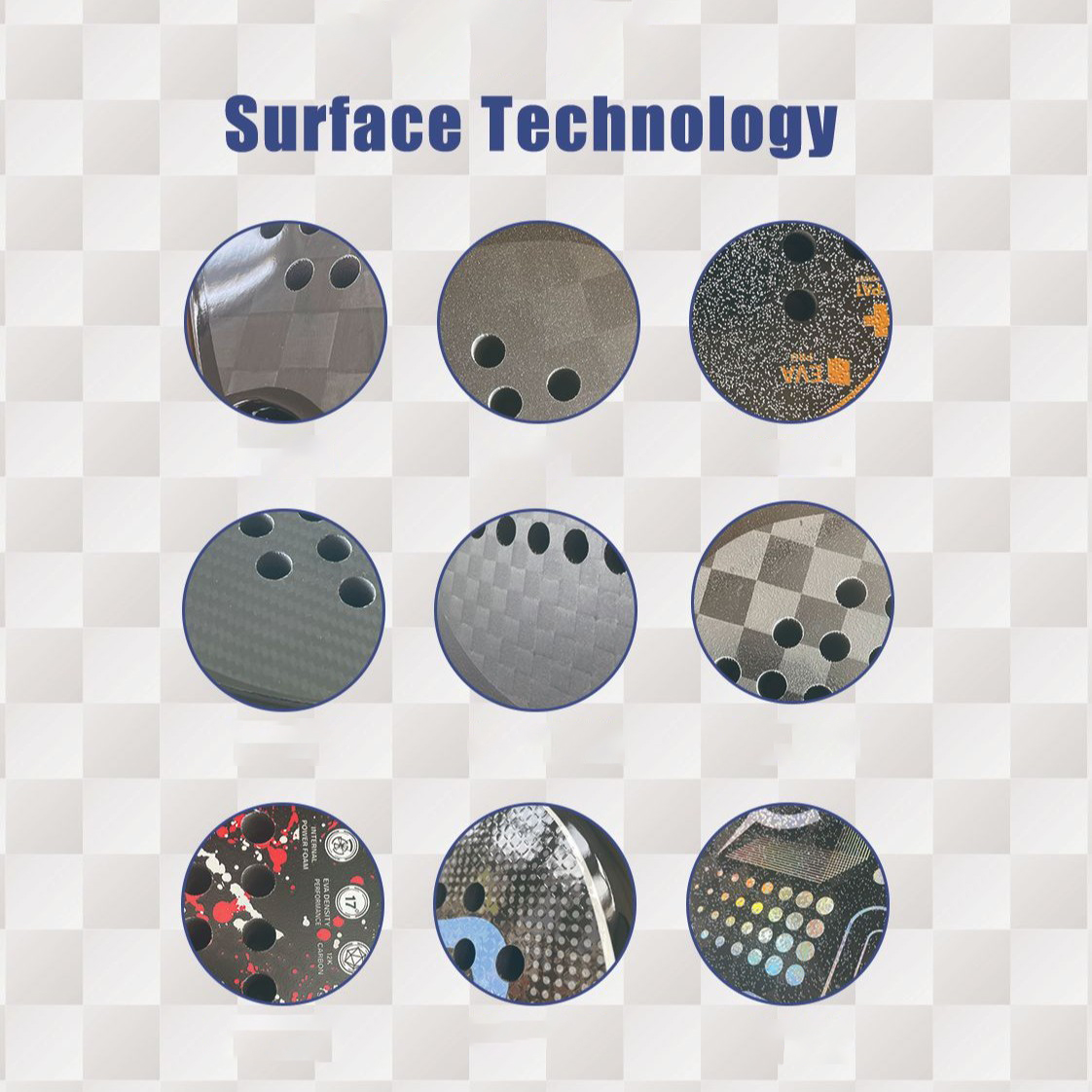
For product managers and equipment buyers developing tournament collections, selecting the right manufacturing methodology to generate surface friction involves balancing maximum initial bite against multi-month abrasion durability. Historically, the industry resolves this challenge through two primary industrial technologies: post-cured silica quartz sandblasting and in-mold 3D laser engraving. In the silica grit process, technicians finish a cured carbon fiber paddle with a specialized adhesive polyurethane primer and pass the frame through an automated pressurized booth that sprays calibrated micro-grains of angular quartz sand or aluminum oxide across the sweet spot, followed by a thin sealing lacquer. Players who test silica-blasted weapons love the aggressive, sandpaper-like padel spin that shreds into wool felt on delicate drop shots and wet-ball exchanges. However, because quartz particles sit atop the exterior paint layer, relentless collisions against sandy balls gradually shear the grit smooth after thirty to forty hours of heavy play. To guarantee permanent rotational consistency, authoritative engineers laser-engrave microscopic geometric reliefs—such as raised hexagonal honeycombs, directional chevron fins, or branded micro-logos—directly into the steel cavity of the compression mold. During high-temperature curing, liquid epoxy resin flows into those laser-etched valleys, forming permanent 3D structural ridges that never peel or wear flat across the entire lifespan of the padel racket.
Over the past two seasons, a third surface engineering innovation borrowed directly from aerospace wing fabrication has captured the enthusiasm of touring professionals and boutique private labels: textured peel-ply curing combined with exposed carbon fiber topography. Traditional decals and heavy paint coatings add ten to fifteen grams of dead static mass to the head while filling in the natural valleys of the woven graphite cloth. In advanced peel-ply manufacturing, technicians lay a sacrificial sheet of coarsely woven, heat-resistant nylon or polyester release fabric directly over the raw 12K or 18K prepreg carbon fiber face prior to closing the heated hydraulic press. As the internal bladder inflates to twelve bar and the epoxy resin cures around one hundred fifty degrees Celsius, the sacrificial fabric presses a uniform, microscopic grid of peaks and valleys directly into the raw resin matrix. Once the cured frame cools and workers strip away the peel-ply cloth, the exposed carbon fiber surface retains an engineered arithmetic mean roughness measuring between eighteen and twenty-five micrometers. Pairing this raw micro-textured resin finish with the natural checkerboard undulation of 18K triaxial carbon ribbons creates a dual-scale friction profile—where macro-weave contours pocket the compressed rubber core while micro-roughness peaks bite into individual wool filaments without adding a single gram of extra paint weight.
Building a commercially dominant equipment catalog requires matching specific surface friction architectures to distinct player tiers and regional court conditions. A brand supplying humid coastal clubs where damp wool balls become heavy and slick may specify hybrid dual-texture faces that combine molded 3D spin ridges with fine quartz micro-grit, whereas a flagship tour line may showcase ultra-light peel-ply raw carbon fiber craftsmanship. Executing these microscopic surface tolerances without creating cosmetic resin blemishes or weight drift requires partnering with a vertically integrated industrial manufacturer. In the global sporting goods manufacturing sector, Taspo Sports stands as a premier racket manufacturer and turnkey ODM engineering partner for prestigious international brands. Operating in-house 3D CAD mold-engraving studios, sub-zero carbon prepreg cleanrooms, automated robotic silica-grit spraying booths, and precision peel-ply lamination lines, Taspo Sports calibrates exact surface roughness values measured on digital profilometers. Every custom padel racket produced by Taspo Sports undergoes rigorous rotational friction audits, two thousand pneumatic cannon impact cycles, and laser-guided static weight sorting held strictly within plus or minus 1.5 grams. Partnering with an established racket manufacturer like Taspo Sports guarantees commercial brands tour-validated padel spin performance, permanent cosmetic durability, and scalable global OEM supply chains.
 Hot News
2026-11-17
2026-11-17
2026-11-17
2026-11-17
2026-11-17
2026-11-17
 EN