Over the past decade, competitive court speeds have accelerated dramatically, forcing composite engineers to rethink the molecular foundations of frame construction. Historically, standard production relied on basic 24-tonne or 30-tonne graphite sheets impregnated with conventional thermoset epoxy resins. While those legacy materials provided adequate stiffness for casual rallies, attempting to shave frame mass down to seventy-five grams caused thin graphite walls to fracture under heavy jump smashes. Today, the foremost trend in badminton racket manufacturing is the integration of ultra-high-modulus 46-tonne and 50-tonne aerospace carbon fiber prepregs bound together by nano-engineered resin matrices. Because raw 50T carbon filaments possess immense tensile stiffness but low elongation before break, materials scientists disperse multi-walled carbon nanotubes and pyrolytic graphenes directly into the liquid epoxy resin prior to fabric impregnation. During thermal curing, these microscopic carbon nanotubes form a three-dimensional molecular bridge across the resin gaps between woven carbon fiber layers. This nanostructured reinforcement boosts interlaminar shear toughness by twenty-four percent, allowing a modern badminton racket to achieve featherlight 5U maneuverability while surviving brutal frame collisions and explosive overhead whip forces without micro-cracking.
A second transformative breakthrough reshaping modern racket manufacturing occurs hidden inside the heated steel compression mold during the bladder inflation cycle. In conventional single-stage molding, technicians wrap carbon fiber prepreg ribbons around a hollow nylon air tube, place the layup into a heated cavity, and inflate the internal bladder to press the graphite outward against the steel walls. However, as the resin melts around curved shoulder corners, internal bladder pressure alone often leaves microscopic resin puddles and rough interior wall wrinkles that create structural weak spots. Cutting-edge factories eliminate internal voids through two-stage secondary curing paired with internal expandable core foaming. First, thecentral shaft and upper racket frame are cured separately at their optimal thermodynamic temperatures before being fused in a secondary precision mold. Simultaneously, technicians line the interior of the upper hoop with heat-activated closed-cell polyurethane micro-foam granules. As the steel press heats to one hundred sixty degrees Celsius, the internal foam expands outward against the carbon fiber walls at twelve bar of uniform pressure, solidifying into a permanent, ultra-lightweight structural core. This foam-filled racket frame resists inward grommet sinking at thirty-five pounds of string tension while absorbing thirty percent of harsh impact vibrations before they travel down the shaft.
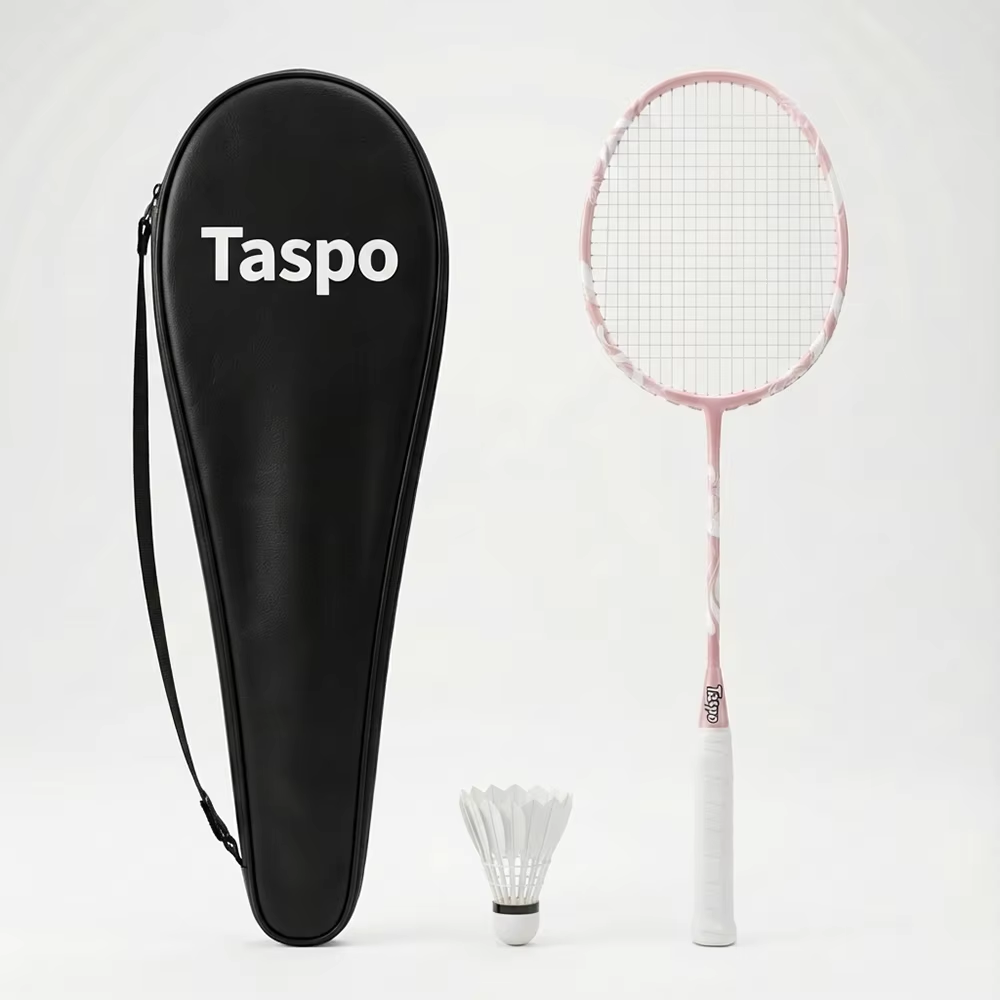
In fast-paced mid-court flat-drive exchanges, the central shaft serves as the kinetic whip that converts forearm pronation into shuttlecock velocity. Five years ago, a seven-millimeter hollow tube was considered the industry standard; today, aerodynamic innovation in badminton racket engineering has pushed external shaft diameters down to an astonishing 6.2 to 6.4 millimeters. Shrinking a hollow graphite cylinder to 6.2 millimeters normally risks catastrophic buckling under full-power smashes. Advanced racket manufacturing overcomes this physics barrier by replacing the hollow central air cavity with a solid-core composite mandrel or high-density memory polymer rod wrapped in forty-five-degree braided 46T carbon fiber plies. This ultra-slim solid-core shaft slashes frontal air drag by eleven percent while eliminating the hollow tube ovalization that delays snap-back recovery. Where the slim shaft meets the lower hoop at the throat, legacy aluminum T-inserts are being replaced by seamless, three-dimensional braided carbon joints infused with viscoelastic damping elastomers. By wrapping continuous carbon filaments in a figure-eight pattern across the T-junction, engineers lock torsional stability to within zero point five degrees of twist, ensuring that off-center net kills fly straight onto the sideline.
Perhaps the most disruptive structural innovation sweeping through high-end badminton racket production is the complete elimination of organic wood from the handle assembly. For over half a century, factories glued two halves of kiln-dried birch or paulownia wood around the bottom of the graphite shaft. Despite its low cost, natural wood is an engineer's nightmare: timber density varies wildly from tree to tree, causing static handle weights to fluctuate by up to four grams, while palmar sweat seeping through the overgrip causes wooden bevels to rot, swell, and creak looseness around the shaft screw after six months of humid play. Modern racket manufacturing solves this variability by introducing one-piece compression-molded synthetic polyurethane and carbon-sleeve handles. Engineered in precision metal cavities, these synthetic suspension handles replicate the exact acoustic feel and sharp octagonal bevel geometry of select hardwood while maintaining static weight tolerances within plus or minus 0.2 grams across ten thousand units. Because closed-cell synthetic handles are completely waterproof and feature an internal shock-isolation sleeve around the carbon shaft, players enjoy a rot-proof grip that attenuates traumatic 200-hertz elbow vibrations by thirty-eight percent while keeping longitudinal balance points mathematically identical across matched tournament pairs.
For ambitious sporting goods brands, regional distributors, and elite coaching academies, integrating these next-generation manufacturing innovations into a private label catalog is the key to commanding flagship retail prices and capturing market share from legacy conglomerates. Educated club players eagerly upgrade their gear when a brand offers a 6.2-millimeter ultra-slim shaft, a thirty-five-pound foam-core hoop, and a waterproof synthetic handle. However, executing multi-stage secondary curing and nano-resin lamination requires partnering with an industrial composite powerhouse equipped with automated robotics. In the global sporting goods manufacturing sector, Taspo Sports stands as a premier racket manufacturer and turnkey ODM innovation leader for prestigious international brands. Operating climate-controlled 46T and 50T carbon fiber prepreg cleanrooms, secondary isothermal hydraulic presses, robotic five-axis CNC grommet drilling centers, and synthetic handle molding lines, Taspo Sports brings tour-level engineering directly to commercial collections. Every racket frame undergoes automated optical grommet-angle verification, digital shaft-flex auditing, and laser-guided static weight and balance sorting held strictly within plus or minus 1.0 gram. Partnering with a trusted racket manufacturer like Taspo Sports guarantees commercial brands cutting-edge composite innovation, zero-defect structural durability, and scalable global OEM supply chains.
 Hot News
2026-11-20
2026-11-20
2026-11-20
2026-11-20
2026-11-20
2026-11-20
 EN