Typing search terms into global business directories or walking the aisles of international sporting goods expos reveals hundreds of companies claiming to manufacture carbon fiber court equipment. For brand founders, club chain directors, and regional distributors wondering where to find reliable custom padel racket suppliers, this crowded digital landscape is full of expensive traps. Over seventy percent of online listings advertising low prices and flashy graphics are actually operated by third-party trading intermediaries sitting in office towers miles away from any molding press. These middlemen collect client deposits, mark up unit prices by twenty-five to thirty percent, and subcontract the actual production to whichever low-cost cottage workshop has spare capacity that week. The classic nightmare scenario happens when a buyer approves a flawless, hand-finished golden sample, only to open a forty-foot ocean container months later filled with rackets suffering from off-center balance points, brittle fiberglass substitutions, and peeling water decals. Bypassing trading brokers to partner directly with an authentic, vertically integrated custom padel racket manufacturer is the single most important strategic move a sports business can make to protect its capital and brand reputation.
Telling a true composite engineering facility apart from a basic assembly workshop requires a structured technical audit before signing any purchase contract. When evaluating custom padel racket suppliers, experienced procurement managers look past showroom aesthetics and demand raw material traceability alongside in-house laboratory verification. A legitimate carbon padel racket supplier maintains direct procurement channels for aerospace-grade polyacrylonitrile carbon fiber tows—such as authentic Toray filaments—and stores its pre-impregnated carbon fabrics inside temperature-controlled walk-in freezers at minus eighteen degrees Celsius so the epoxy resin never cures prematurely before molding. Furthermore, a trustworthy factory never relies on guesswork to validate structural durability. During a live video audit or on-site inspection, buyers should ask to see the quality assurance testing lab in action. Top-tier manufacturers utilize automated three-point frame bending machines, pneumatic cannon impact testers that fire high-velocity balls against the face five thousand times, and digital swing-weight scales. If a prospective wholesale padel racket supplier cannot produce batch traceability logs or lacks dedicated mechanical stress-testing rigs on their shop floor, they do not have the quality infrastructure required to support a commercial sports brand.
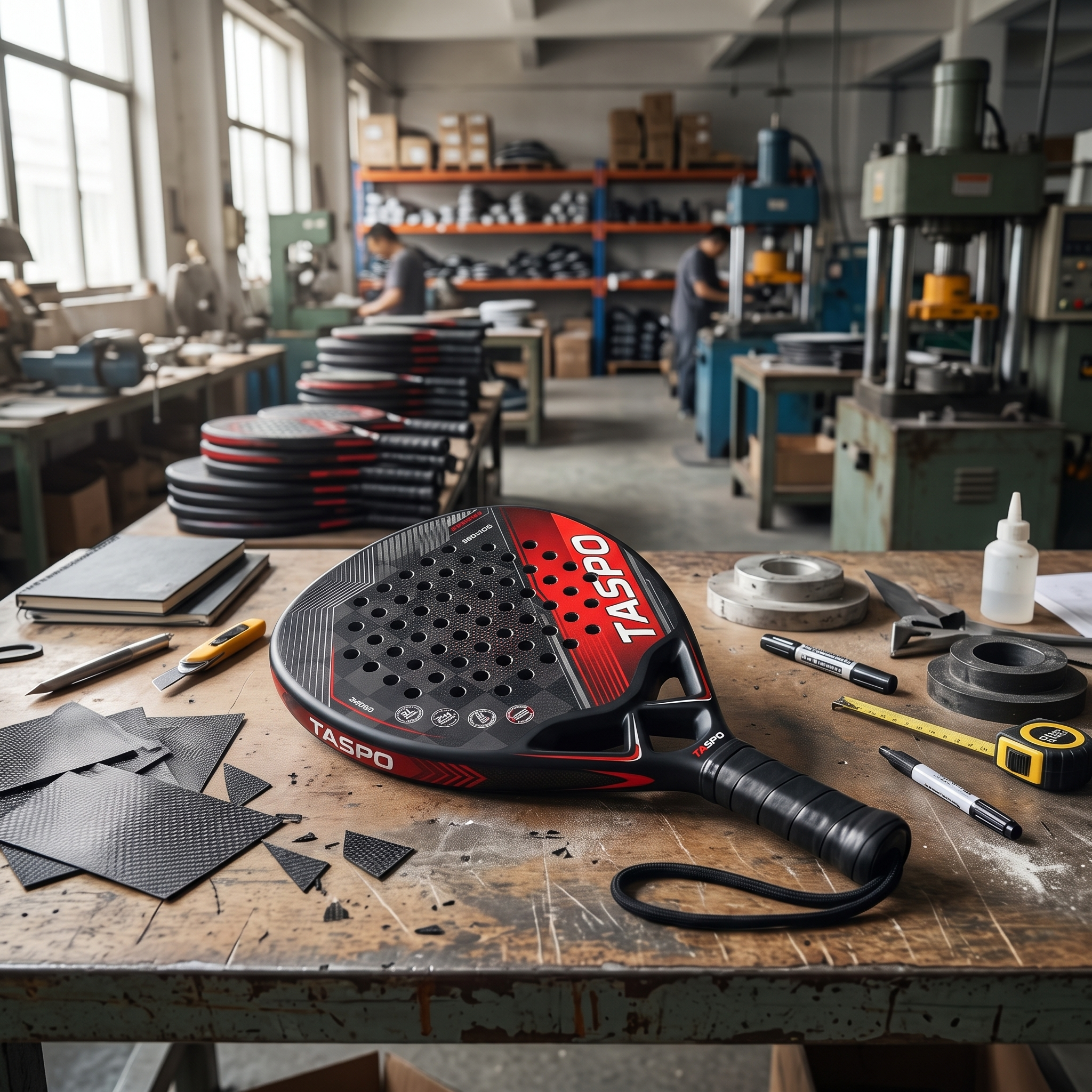
Walking down the production line of an advanced factory highlights two technological bottlenecks that separate tour-grade hardware from bargain-bin defects: hole machining and cosmetic coating. After a padel frame emerges from the hydraulic thermal press and cools inside stabilizing jigs, sixty to seventy aerodynamic holes must be cut through the carbon sandwich face and EVA foam core. Low-end workshops use manual drill presses or blunt stamping dies that rip through the composite skin, creating invisible microscopic fractures around every hole perimeter. Within three weeks of aggressive overhead smashing on the court, those micro-cracks connect and split the racket face wide open. In contrast, reliable custom padel racket suppliers invest heavily in multi-axis Computer Numerical Control diamond-bit drilling stations. Automated CNC spindles drill at high rotational speeds with programmable feed rates, leaving glass-smooth hole edges that preserve structural integrity and optimize airflow during fast volleys. Immediately following sanding and priming, elite factories route frames through pressurized, dust-free robotic spray booths and ultraviolet curing tunnels. This clean-room finishing process guarantees that matte, glossy, or 3D sand-grit coatings pass strict cross-hatch adhesion tests without trapping dust specks or yellowing under outdoor stadium sunlight.
Looking at real supply chain restructurings across high-growth racket markets proves how switching to a verified direct manufacturer transforms business profitability. Consider a fast-growing athletic equipment brand operating across Chile, Argentina, and Mexico that initially sourced its three-model catalog through a general sporting goods trading company. For two years, the brand struggled with ninety-day delivery delays that caused them to miss peak summer tournament windows, while inconsistent epoxy curing led to a nine percent retail warranty replacement rate that wiped out their marketing budget. Determined to fix their foundation, the founders conducted a comprehensive factory audit and moved their entire production to a specialized custom padel racket manufacturer with integrated molding and finishing lines. Direct factory engineering immediately lowered their landed unit cost by twenty-eight percent while upgrading the face material to genuine 12K woven carbon with high-recovery black EVA cores. Lead times dropped from eighty-five days down to thirty-eight days, warranty claims fell below zero point four percent, and the rock-solid product consistency enabled the brand to secure nationwide shelf placement inside South America’s largest department store chain within two quarters.
For sporting goods executives, club operators, and private label entrepreneurs searching for a dependable long-term production home, Taspo represents the gold standard among custom padel racket suppliers worldwide. Rather than operating as a simple contract assembler, Taspo functions as a full-scale composite research, design, and manufacturing powerhouse compliant with strict ISO quality management benchmarks. Inside Taspo’s modern industrial facility, dedicated engineering teams oversee every single stage of the lifecycle—from cold-storage prepreg carbon management, precision hydraulic thermal molding, and automated CNC hole drilling to climate-controlled UV decal finishing and digital weight-and-balance sorting. Whether a growing brand needs low minimum order quantities using proven open molds to test a new market, or an established distributor requires bespoke 3D private mold tooling with custom 18K aluminized carbon layups and anti-vibration handle systems, Taspo delivers unmatched transparency and on-time execution. Even better, partners can consolidate their carbon padel racket production with Taspo’s tournament-grade court balls, custom overgrips, sweatbands, and thermal bags in a single container, streamlining global logistics and building an unstoppable court brand.
 Hot News
2026-11-20
2026-11-20
2026-11-20
2026-11-20
2026-11-20
2026-11-20
 EN